Showing posts with label markets. Show all posts

Wednesday, August 6, 2014

Everyday I Write the Book

Executives are pressured to be budget-minded while increasing sales and productivity.  “Do more with less” is the banner many are forced to hold high while walking across the customer service area or the down the manufacturing line.  The pressure of expanding territory, managing the brand(s), and keeping talent in the building require complicated maneuvering.  While begging, pleading and groveling tend to be our default posture, we can really choose differently and with a better chance for lasting effect.

A detailed, passionate plan is necessary for a Human Resources professional to be engaged in the business process.  We have to sit down and create an action plan with both pre- and post-process details.  This may very well be a daily process.  There are moving parts and market fluctuations that cannot be depended on to remain static.  The dynamic nature of our commerce requires us to be nimble and adaptable.  Write and review processes everyday.  Grab your coffee (or latte or Oprah Chai Tea or whatever it is you like today).

Pre-Process:
  • Where are the pain points of the company?
  • How did it get this way?  What has to change?
  • What are the expectations for the company as described by the Executive team?
  • Who should be handling certain components of the process?  When can I sit with them to review?

Post-Process:
  • What elements were accomplished?  What’s working well?
  • Where are there still missing pieces? Who is addressing those needs?  How?
  • Who is/was unable to handle the responsibilities given?  Time for change?

These questions can be drilled down more, but the general idea is to challenge yourself to answer them.  Sit down ahead of time with the pre-process list of questions and write down answers.  When we answer them in our heads only, it’s often the case that’s where they’ll stay.  Write the answers; from these answers, an action plan is created.  This is not an exercise in accountability only, but also in planning with purpose. 

Our companies are in need of dynamic resources to handle the mandate of “more with less.”  I don’t see this trend changing anytime soon.  The fear of finances around tax increases, ACA compliance and global military activity is real and impacts markets.

Listen, for those of you still holding onto hope that you’ll be allowed to fill that job requisition for additional help in your department…let it go.  Don’t depend on it.  It’s been two years.  The company is not bringing on another HR Generalist for you.  Be creative, be industrious, but don’t be stupid.  If the answer is that next quarter might look better and we’ll see then, give it up.  Work with what you have; just work it stronger and with real expectations.  I have had the opportunity to sit with HR departments who regale me with the plans they have for an additional person they’ll eventually be allowed to have.  In the meantime, though, that list of work and plans sits dormant waiting for that person.  Why?

Meet with the executive team to determine the fiscal expectations of the company for the next 6 months.  Then take that understanding and create the process list for pre-, during and post-.  Assign roles, speak to the cultural leadership needed and provide timelines.  Yes, hold people accountable, including yourself, but do it based upon a clearer understanding of the expectations of the company’s financial strategy. 

Oh yea, for those of you reading this who are saying, “no one on the executive team shares this with HR,” then figure out how to make them.  Give them the business case for HR’s involvement.  Show them what you know how to do.  Let them see the resources you have ready to go once you know where you’re going.  Of all people, HR seems to know how to do more with less.  We’ve done it for decades. 


Friday, February 7, 2014

Candy Everybody Wants

SMH.  How cool am I?  I know that SMH means “Shaking My Head” in text and social media chat.  OK, you might not think I am that cool, but I do (and isn’t that all that really matters? Ok, not really).  We do know that just because you know the latest slang, technology or fashion doesn’t make you relevant.  Relevance comes from true engagement.

OK, what the heck does that mean?  Sounds like the latest talking point for me to use as a keynote.  I can travel from SHRM Chapter to SHRM Chapter and sing the values of true engagement.  “For only $39.95, learn all of the secrets of true engagement that will transform your business, your marriage and your life! Act now and I’ll throw in a Ronco Potato Peeler absolutely free! (Just pay shipping and handling)”.  Nice, right?

True engagement is about connectivity.  For business-minded people, this means connection to competition, market conditions, market changes, talent trends in skill sets and training, strategies around retention and succession planning, etc.  I will be relevant when I am relevant.  I don’t look or sound relevant alone; I am to be relevant in what I do, too.  Often this requires an investment in time to determine where my resources are better spent moving forward.  I assess situations, weigh the facts, research what I don’t know and make decisions.  This screams of relevance.

As people, we yearn for connection to others, to ideals, to purpose.  When something is out of line, we seek to find a replacement for what’s missing.  One of my recent favorite actors died this week.  Phillip Seymour Hoffman could draw you in to the role he was playing.  You believed it was real.  You tracked with him.  You could connect with the performance.  Out of the limelight, he struggled with the same things we all struggle with – relationships, meaning, direction.  What he ran to for answers did not provide what he was ultimately looking for, but don’t think he’s alone in that.  I am not speaking of drug use, but on a grander scale, running to something easy to fill the deeper.

Our relevance is not bound to coolness.  When I sit and listen to someone pushing a book about how to be relevant to Gen Y, for example, I could get up and punch them in the middle of their speech. (I mean, slap them, ‘er, rather, give them a stern glare…ah, that’s more HR).  Tell me how to measure competition better, how to measure and read financials better, how to discover better talent and recruit more effectively.  That’s what will make me relevant to the workplace, not a Blu-ray in the breakroom or $5 Starbucks gift cards on an employee’s birthday (OK, I don’t really mind that one, but…). 

Your connection comes from putting yourself in places to be connected.  What are you spending your time on?  Is it profitable?  Is it bottom-line driven?  We are so much better than flash and glitz; we are substance.  Our purpose comes from pursuit of such things; work to fight against those things that would distract us from our meaning.  We have depth.  We bring purpose to the table for others to share.  We are relevant to our companies, our homes, and our country when we pursue connection to real, lasting principles.  For our business communities, these principles must be foundational and returned to time and again.


There will come a time when I will no longer be able to physically pursue some of these things, and as such, my relevance may slip.  May I remain strong in my core to not become discouraged.  My mind may want more, but my body may hold me back.  But maybe, by that time, the Ronco Relevance Infuser will be on the market.  Of course, I will be first in line…SMH


Tuesday, January 28, 2014

The Future's So Bright (I Gotta Wear Shades)

Post by +Victorio Milian - Twitter @Victorio_M

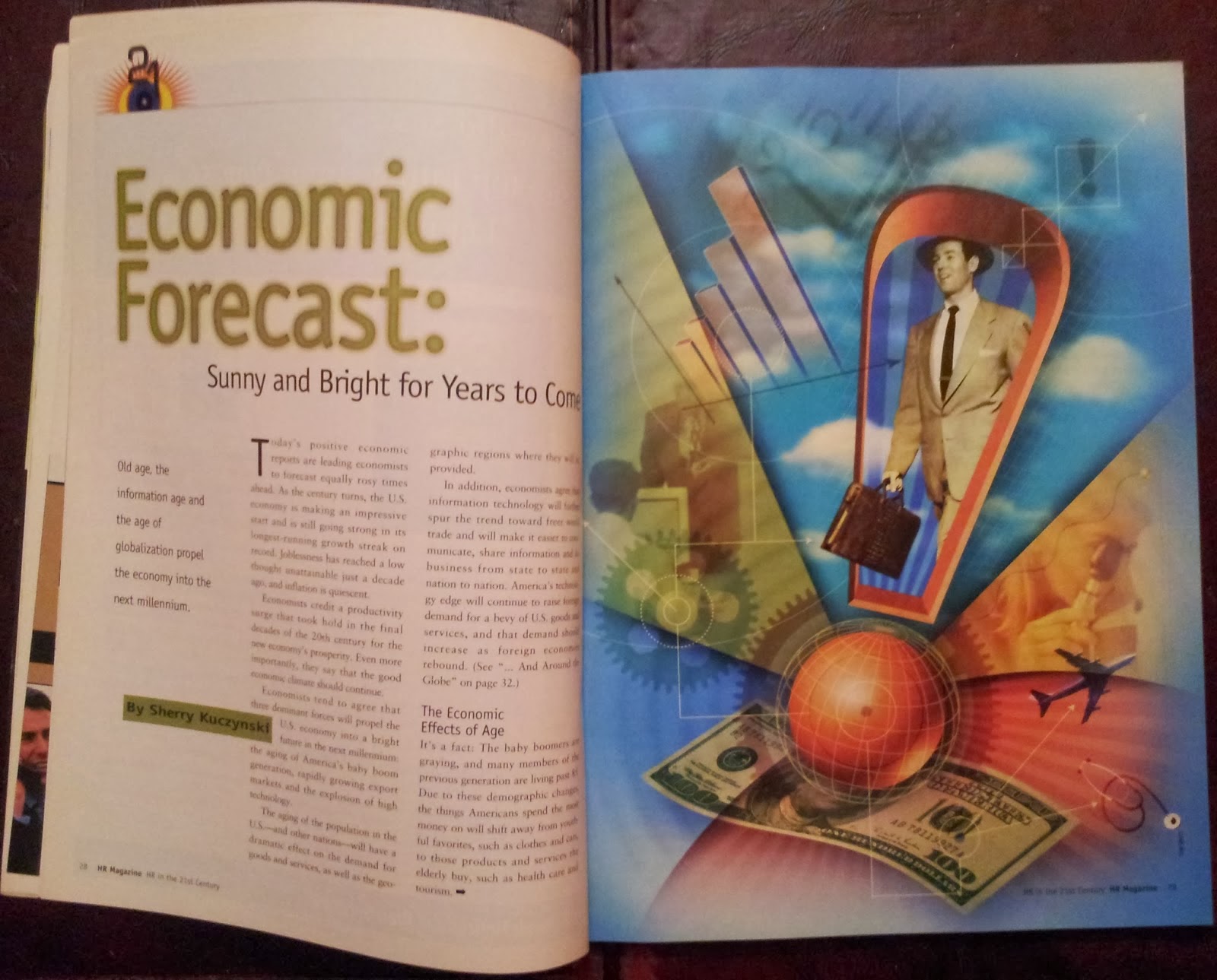
I was cleaning up the office that I use when I work onsite for one of my clients when I came across a stack of magazines. They were from HR Magazine, which is published by SHRM, the world's largest Human Resources association.
I love HR, but does anyone else?
It's been a while since I saw one so I started looking through them. And then I saw this one:
A collector's item, perhaps?
It's from 1999. Wow.
You can't see it in this picture but there's more to the headline than just "The 21st Century." At the bottom it states, "What's in Store for HR?"
Inside, there are various articles, all attempting to answer the above question. The contributors discuss the different generations in the workplace. They attempt to interpret the potential legal, technological, and economic landscape that Human Resources practitioners may find themselves in. Advice is offered on how HR and business leaders can best prepare themselves for these changes. 
The future's so bright, I gotta wear shades...
As with any attempt to peer into the future, some of what's discussed seems to be an extrapolation of (then) current information. For example, the idea that when Baby Boomers retire it will potentially bring about a shortage of skilled workers.

"From 2000 to 2020, annual unemployment rates fluctuate between 3.5 percent and 6.5 percent, averaging about 4.7 percent."-quote from an article within the 1999 HR Magazine

Back in 1999 I wasn't a HR professional yet. I wasn't focused on the future. My mind was on the present, which consisted of bills and building a relationship with my future wife. Oh, and the Y2K scare.
Were HR/business leaders at the time looking ahead? Were they preparing themselves and their workforces? And could anyone have predicted the last 14 years?
  • Terrorism
  • Global Recession
  • The rise of the global economy, particularly Brazil, Russia, India, China, and South Africa (the BRICS)
  • The United States electing its first African American President
As we've seen, the future is chaos. While we can get some things right, it's impossible to figure out completely. Regardless of how we may feel about the events that have shaped our current reality, it's important to never stop looking to and preparing for the future. We owe it to ourselves, and to those we impact.

How are you preparing yourself and your workforce for the future?


Wednesday, April 3, 2013

She Works Hard for the Money

With all of the talk of the Yahoo flexible staffing changes, much conversation has been had about measuring productivity.  Some have argued that working from home means that there is no supervision and therefore less work is really being done.  Some have said quite the opposite - freedom in flexibility drives people to work harder.  Both sides have presented stats to support their position.  So how do you decide?

In some ways, I'm a bit old school.  I believe in hard work for great results.  I believe in an honest day's wages for an honest day's work.  I believe no one owes you anything.  Most of this perspective comes from my family.  I was raised with a work ethic that was without excuse.  My dad was out of work for over a year in the mid to late 70's and he tried to find a job in his field while he was remodeling kitchens and hanging Sheetrock/drywall on the side.  He worked weekends and evenings.  He knew he had a family to provide for and that was his mission.  He wasn't too proud to lift a phone, a frying pan, a hammer.

Now, I understand that nostalgia is just that.  It's a sentimental remembrance of a time gone by.  Time moves on and things change.  I know that there are numerous people in an unemployment line today that feel that same passion to provide.  I am heartbroken for the families that are struggling today and searching diligently for work.  What I, also, know is that each week, I hear from a different person who brings up the feel of the workplace today and the air of entitlement that is pervasive throughout.  Nostalgia aside, somewhere we've lost drive.

Where did it go?  Are we lazier?  More tired?  Stretched too thin?  Burned out?  Disenfranchised?  No longer hungry?  You tell me.  I have read the "experts"; I have read books by some smart people.  I have read countless blogs telling me what's wrong.  So what do we do?  I am practical in my business sense.  In human resources, I don't believe in programs for programs-sake.  Everything that HR does should point to the business bottom line.  If it doesn't, then stop it.  Time and resources are too precious.  We've got to create an action plan to get motivated and get working again.

As some of you have learned, you can only control what you can control.  I didn't learn that from a fortune cookie (although, I should look into starting a business making them...side note!).  I learned this from experience.  When I was in my 20's, I was going to change the world.  In my 30's, the world crapped on me.  And now in my 40's (man, that's still hard to write), I have become laser-focused in the ways I can make change happen.  I do have control over behaviors and actions; I don't have control over the world or all of life.  The action plan we can create to conquer should be based on behavioral and attitudinal change along with clarity in mission.

We should be on a mission to get back to hard work.  The turn-around is not going to be easy.  We are living in a country that is falling down the list as measured against other countries.  We're 12th in GDP, 6th in innovation and technology and 7th in overall global competitiveness http://www3.weforum.org/docs/WEF_GlobalCompetitivenessReport_2012-13.pdf.  (And if you're in HR and you don't know what some of these measurements or terms are, then you had better get an education quickly.)  It was not that long ago that the US was 1st in everything.  To lose this much ground is unsettling and it should cause us to want to roll up our sleeves and work hard.  

We're in a war for talent.  Yahoo is implementing the changes to flexible staffing and schedules because they want to know that the talent they are investing in is returning a profit for the company.  Measurement is telling them otherwise, hence the changes.  I would argue, though, that we're not in a war for talent...we're in a war for GREAT talent.  The pool of people who really fit the bill for what an employer is looking for has shrunk. Companies wind up settling in hiring because they just cannot find the superstars needed.

Some of this can be remedied by expectation from the employer.  Not everyone can be the verbose sales manager that wins over a room with his/her personality and charisma.  Not having those traits does not make someone a less desirable candidate.  Can you imagine an office full of Michael Scotts or Chris Varicks or Joe Isuzus? (Google them if you don't know).  It would be way too much.  Superstars run the gamut of personality and approach, but can still produce results.  Dig deeper in interviews; be situational and behavioral in questioning.  This is where the work should happen in bringing the right people on board.

Another part of this can be remedied by each and everyone of us.  We've got to work harder.  I'm serious.  There are millions of us who've been infected with the entitlement bug.  Take some antibiotics and move on.  We deserve what we really work for.  One of my favorite business biographies is about Hershey's. Milton Hershey failed seven times in business creation and went bankrupt a couple of times.  And yet, he awoke each day determined to make what he knew would work.  He refined candy making processes, he sought out better ingredients and he went door to door and in every venue he could to showcase his results.  He worked hard for his success.

I know that there are some of you reading this who are already traveling this road and have this perspective.  I see the work you do and I know the results are measurable and real.  Allow me to say "Bravo" for not only your work, but for your example to others.  You are most appreciated and very much needed in our businesses.

For those who will take the time to reflect on this, perhaps it will inspire you to take some action steps.  Have you gotten a bit lazy in your work ethic?  Is there an entitlement issue at the core?  Identify, create a remedy process and seek out accountability in a trusted business friend.  Hold yourself to the highest standard you can; forget about what everyone else is doing or isn't doing.

I believe in working hard.  We work hard to earn a decent living.  We work hard to set an example for future generations so they'll know what it takes to maintain and surpass.  We work hard to influence societal greatness.  We have done it and we can work to do it again. 


Wednesday, December 19, 2012

Giving You The Best That I Got

Personal excellence is not a lost art.  You know, we can work to be excellent at all that we do.  My wife shared with me that a friend stays motivated to fold laundry because she thinks about where the kids will be when they are wearing the clothing and the fun & learning they'll be experiencing.  She imagines this and is excited to be a part of it.  Wow.  I am "cranky pants on steroids" when I am left to empty the dishwasher.

At the workplace, many would just laugh at such a perspective.  Why would I be excited to make another widget for someone to use doing something that I don't really care about?  Engagement with the task at hand is not easy to maintain at a high level.  There are days when it's just not exciting to represent a company in service or production. My question, though, is does it have to be?

Self-fulfilling prophecies happen.  If you tell yourself that you'll fail, you will.  If you are sure that a certain person won't be attracted to you and therefore wouldn't say yes to a date, you're probably correct.  We believe the imposed hype much more than we should.  In physical exercise, this is referred to as unhealthy self-talk.  The exercise isn't the issue; it's the negativity that runs through your head that's a problem.  Isn't it possible that a reason you are not at the performance level you'd like to be or at the management level you'd like to be is because you don't really believe you can?

When a decision is made to accept a job offer, it is not common for the new employee to walk in thinking, "How can I do the least amount of work possible and still get paid?"  I'm not saying this never happens, but it is not the common approach.  Most will want to do a great job by giving great effort.  At what point did giving the best that you've got become passe?

Listen, even though I may not know you, I know you.  We all get hung up on lousy managers, lousy processes, lousy total rewards plans...I get it and I have belly-ached about those things, too.  But one thing I am more sure of now then ever before is that I allowed those things to take away my power to be excellent in what I do.  I settled for half-best rather than the best best I could offer.  I downplayed my talents in order to make room for the complaining.  I robbed myself of personal growth because I was frustrated, angry or fed up with the work I was doing or the company I was doing it for.  No more.

Let's walk into the new year convinced that we are awesome, convinced that we can be excellent at what we do.  Let's stop playing those negative tapes and make the decision, despite all of the reasons to complain, to excel at our work.  We spend so much time working, why not make it rich and valuable?  Why not change our perspective so that we pursue excellence?

I understand that some of you will read this and think I am being too sensitive or too Stuart Smalley-like.  I would have to come back to you and say I am not.  This isn't about feeling good, primarily, although that will be a by-product.  I am coming at this a bit more strategically.  According to the World Economic Forum, the United States has fallen to fifth in ranking; the US was last in first place in 2008.  Each year since has seen another step down the world business/economic health rankings.  

The US worker is one of the best in the world, hands down.  As such, we must reflect what we are.  To compete in the global market, which we ALL do to some degree, we must function at a higher level of excellence than our competition.  Giving the best that we've got is necessary more than ever; our country has to regain lost ground.  Product development, technology and innovation, and improved processes are crucial; however, without excited and committed human capital, these initiatives will fall flat.  We make the difference.

The new year is right around the corner.  Take some time to realign your enthusiasm and your commitment to the work you do.  You are in the role you are in for a reason.  Believe in what you know how to do.  It matters to your co-workers, your management, your company and your country...it should matter to you.


Thursday, August 23, 2012

O Company, My Company...Don't Get Comfortable!


It’s very easy to hit auto-pilot on your company’s existence.  There are no big issues, production is basically level and employees come to work most days.  Seems to be fine.

Is the goal of the American company to cruise?  T. Harv Ecker is quoted as saying, “If you’re not growing, you’re dying.”  Perhaps this is familiar to you, but is there motivating power behind it?  The words might ring true, but the goal of the saying is not to merely recognize a truth; rather, it is meant to inspire growth and to turn away from the apathy or stagnation in which you might find yourself or your company.

I have found it interesting to watch companies miss strategic growth initiatives because of being comfortable and thinking that’s good enough.  Ask Kodak or Blockbuster about missing business development opportunities.  Where would those companies be if they had paid attention to the markets and to technology more intently?  What if they had led the charge rather than being punished for missing the charge altogether?

Strategic business growth takes a bit of pain and discomfort.  There will be trials and errors, but that will help to establish a culture of innovation and of growth.  The healthiest plant is pruned so that it will flourish more and produce fruit.  Why would that concept not apply to an organization?  Sustainable corporate growth comes out of a strategic, thoughtful plan with the goal of capitalizing in a particular market or markets.  Companies are desperate to find a way to do this.

While this may not happen in companies today because they are comfortable, it is certainly not the only reason.  Companies may not have the resources, know-how or time to develop and drive a plan.  I have not found the company that says it does not want to grow and become more successful (I’m sure they are out there), but good intentions will not change the direction a company needs to go.  A plan is needed.

Humareso is here to make that plan happen.

Monday, August 20, 2012

Oh, the Amazing Companies We Work For...or Not


Amazing.  That word is used very often in our American culture.  Has it lost its meaning through overuse?  Does it cause a reader or hearer of the word to stop in his/her tracks as it was intended?

The dictionary defines the adjective “amazing” as causing great surprise or sudden wonder (www.dictionary.com).  When the word is used today, does that ring true to the noun it is describing?  I have had an amazing vacation and my children are amazing, but does the meaning in those contexts lose its force when I have also said that my shoes are amazing or that the chocolate water ice I just ate was amazing?

If everything is amazing, then nothing really is. 

So, when it comes to businesses, does the word amazing enter your mind?  Do you only have pictures of Google and Apple when you think of the word connected to companies?  Is the reason those companies are amazing due to their technology, their dress code or their in-house dry cleaning service (ok, I really do like the last one).  In a world where many things are amazing, why is it a rarity to hear it used of a company?

In the US today, there is a lack of “amazingness” due in large part to the overall health of the companies we work for and own.  A natural pulse of the organization is missing, mostly due to the desperate view of production.  Those quotas are often the primary “what I care about” for management and shareholders.  While I would never say that those numbers don’t matter, what I would say is that those numbers may be a percentage of what they could be if there was a commitment to organizational health and true organizational development.

This is a worthy concept and one that needs much more unpacking.  For now, ask yourself a few questions:
  •          What do I think of my organization?  Is it amazing?
  •          What do I understand of the stated values of the company versus the real values of the company?  Is there a difference?
  •          Is the health of my organization something I have even considered?  If so, in what context?

It is quite possible that you are a key person in the health check of your company.  Take some time to consider.  And have an AMAZING day!