Showing posts with label work ethic. Show all posts

Thursday, March 17, 2016

Are You Gonna Go My Way?

Labeling is an easy skill for most of us.  Our minds have been trained to categorize and label people, things and places.  There are schemata filling the schema in our brains.  In other words, files filling file cabinets in our minds with connections and definitions.  It's why you might smell something, good or bad, and connect it to a memory, a place, a person or a time.  We label.

For those of you re-watching episodes on MeTV of "Happy Days" (or maybe watching them for the first time), you know that the coolest guy on the earth in the 1970's was Arthur Fonzarelli, aka Fonzie.  Initially labeled a juvenile delinquent, Fonzie rose to show a deeper character and a true coolness.  When an organization that worked with kids with who suffered serious abuse and were emotional stifled came to the attention of director Garry Marshall, he wanted Fonzie to alter the label of super-cool a bit.  When Fonzie cried in one episode, and those kids watched it, the result was an open door for that agency to help those kids.  They were ready to emote since Fonzie did.

The labeling takes over rather quickly, however.  We decide who is a jerk, who is nice, who is conceited, who is fake, who is a wimp.  We connect people into categories and then treat the group in that category in the same manner.  We respond singularly, for example, to someone who is mean.  For some of us, we retreat from such a person.  For others, we look to engage and rip apart that person.  It's a sport - the art of the run and the art of the fight.  We all travel the scale and, for some of us, we have to manage people on the same scale.

Our involvement in the label movement is an everyday contribution.  When we treat our employees in a responsive manner rather than at the level we want them to operate, we display our commitment to the label rather than the person.  To be sure, there are jerks.  Of course, those jerks might not be long for their employment.  Yet, even if they are  to be with you for a short time, let's engage them in a way that calls them to greatness rather than meets them in their jerkiness.

As you think about how you're reacting, consider these thoughts:
  • Check your tone - are you sharper with a particular person than others?  Is your label of that person the reason for the difficulty in communication?
  • Re-read emails before you send them - when tone is hard to know, as it is in emails, it means that a bit more time should be spent re-reading prior to send.  You may be giving shade, even unintentionally, by doors you've left open for interpretation of words (and, yes, I said "shade").
  • Examine distribution of work  - are you sharing types of work as well as the amount of work equally, based upon skill sets alone?  Or are you giving the crappy work only to the employee you've labeled negatively?
  • Rotate opportunities to lead - Allow staff to take turns leading various meetings, training sessions or projects.  By rotating the team leader, you are sure that you're negative slant towards someone isn't getting in the way of job expectations and opportunities.
If you're thinking, "I would never let So-And-So lead a meeting or be in charge of a specific type of work", that's fine.  I would just ask back, "Well, then, why is he/she still working at the company?"  If the basis work of work isn't being met that you've uniformly given, then the employment of that person should end.  The work is the reason a person is hired.  

Bear in mind, too, that people might just sometimes surprise you.  The jerk could let his/her guard down and show you how wonderful he/she is.  The wimp might find his/her courage due to the way you're running the department.  The fake might become the most authentic person on your team as he/she learns that skill sets and work product matter more than the facade portrayed.  If Fonzie can cry, then any of these changes could happen. Heyyyyy...


Thursday, September 17, 2015

Digging Your Scene

Dance, baby, dance.  Get up and move.  Shake your thing.  That’s it, make it groove.  Use your hips.  Get down into the floor.  Arch your back more.  Work it!

Those are various performance phrases used in the dance world to encourage excellence in the performer.  Uncomfortable?  Did it make you think I’d finally snapped?  (Don’t answer that).  A dancer needs to have his/her performance graded early on so that he/she can make corrections to the movement in the dance.  If a choreographer has developed a sequence of movement to tell a story and thoughtfully chosen a piece of music to compliment the story, it’s vital that the dancer perform the movement exactly to match the intention of the story.  Real time performance review is necessary.

In the case of the dancer, the choreographer is there teaching the dance.  He/She can then provide timely feedback, such as listed above, and encourage the dancer to move differently or with more precision when working to execute the story through dance.  Travis Wall, one of the best current choreographers, has to be unyielding in seeing his vision executed and so has to watch his dancers often and provide commentary.  A dancer then adjusts in real time.  And when the performance is shared with an audience, the efforts are displayed, and in Travis’s case, usually without flaw.

Intentionally taking the time to watch the scenes of performance that our employees create is a responsibility of management.  It is not to sit in an office and hope they are doing what they should be.  It’s not just looking at numbers at the end of a day or week, and then make grandiose decisions about staffing and product or service implementation.  The repetition of bad choices made in this context overflows into poor corporate culture, low gross sales, inferior candidates and frustrated management. 

Watch what’s happening in the “dance” scenes you’re creating at work.  Give feedback.  It does not need to be done via the official performance review annual form.  It doesn’t have to be a quarterly review.  It CAN include those things, but that’s not all it is.

As a kid, when I was doing my homework, my mom would look over my shoulder every so often to check.  If the writing was rushed and sloppy, she would tell me to erase it and write it again.  The longer she took to check in on me left open the possibility that I would have more to erase.  If she caught me after only doing a few, it was more manageable to correct the behavior and the remaining work was done neater.  It’s the same for management.  Observe often.

Micromanagement, by the way, is not the same as observing often.  A course correction is the responsibility of the manager by knowing why and how staff are travelling a certain road.  A micromanager is telling staff how to move their left foot forward, and then the right foot, and then the left again, and then the right and so on.  Travis can dance the choreography he creates himself, but the point is to take that vision and entrust it to the skill sets demonstrated in the dancers he works with regularly.  The cause is spread to a wider circle and therefore a wider impact.

Give staff the opportunity to perform.  Tell them the objectives and watch what they do.   And along the way, affirm what’s working and advise on what should look or be different.  Keep coming back to the mission or purpose of the work.  Managers have to be involved in what their teams are doing, with consistency and investment.  Come up alongside those employees who are working to make the mission happen and encourage them.  Praise and critique are encouraging, if it comes from an involved, invested perspective.  Do your staff see you that way?

The surprise in good performance review is that it seems very much like conversation.  It feels very much like smart people sitting together to get better at the responsibilities they have.  It opens the door for a deeper understanding of the support, tools and practice needed.  And it also allows for honest dialogue, due to the consistency of review, regarding who can do what’s needed.  Sometimes staff will even call themselves out to say that they don’t have the full skill set required.  And those are employees you want to keep for a long time, even if it means a role change.

Like me, for instance.  I know that in my mind, I dance with as much passion and skill as Alex Wong and could absolutely handle the choreography of Travis Wall.  And though I have been known to “get down”, the vision in my mind won’t make it a reality.  When I leap around the house with my daughters, they remind me, too, that I might not quite have the skills to dance or to choreograph.  Seriously? Have you seen me do the Cha-Cha Slide? Breathtaking. 


Thursday, August 6, 2015

Apologize

Simple: When you do something wrong, say you’re sorry.  Whether that action was purposeful or accidental, a sincere apology should be offered to those affected by the action(s).  It’s very simple.  Yet, the truth is that it’s hard to do. 

We love to watch others mess up, though, don’t we?  We are outraged at public figures who make mistakes – small and large – and then have to apologize in public ways.  Tiger Woods, Bill Clinton, Michael Phelps, Ariana Grande, Charlie Sheen, Kanye West, Hope Solo, Mel Gibson, Michael Vick, etc. have all had to do it.  We hunker down to watch TMZ show us all of the dirt that lead to the apology and then listen to interviews of “professionals” who diagnose the apologies offered.  We are sick people.

On an individual basis, we don’t like being wrong.  Usually, it’s because we really don’t think we’re wrong.  We choose to put our efforts into defending our position, outlining the course of events that lead to the repercussions and to bringing up the twelve previous wrongs of the “offended” party.  We’d rather keep the truth of our wrongdoing to ourselves.

Consider this: How many people do you think do wrong things daily?  Even if 75% of those doing wrong do so on purpose, there are still 25% of those who’ve done wrong without intention.  Why should it be hard for 25% of the population to apologize when a mistake is made?  FYI – that would be about 1.75 billion people.  There would be media coverage and interviews due to the buzz of apology.

In our businesses, why is the act of apology disproportionate?  Specifically, why is it difficult to have senior leadership own their shortcomings?  News flash: There are qualified individuals in senior leadership roles who make mistakes.  Think about the first time you held a new position.  Not just with a new company, but the position itself was new to you.  You’d never been a manager before.  A director, a VP, or a CEO before.  It had to be the first time at some point.  Why would anyone think that someone in a new role would get it all right all of the time?  Apologies should be expected to come.

And pride?  Please.  You’re going to make mistakes.  Own them.  Your pride can handle it, and if you think it can’t, you shouldn’t be working where you work, or in the role you have…or with people.  Own it and say you’re sorry.  You cannot really think that you are the first to make an error, do you?  You think because you’re a CEO, you will damage your reputation or status as a leader by owning mistakes?  Think about what you’re doing to your reputation by not owning the mistakes you’ve made.  Everyone knows already; your screw-ups aren’t a secret.

The other side of the coin is not right either.  Don’t you know someone who often begins sentences with, “I’m sorry”?  Stop apologizing for so much.  When you say you’re sorry all of the time, it’s like crying wolf.  It loses its punch and sincerity.  What about when you really need to apologize?  Won’t it seem like every other sentence?

Offering the apology is appropriate when something was done wrong.  Offering the apology is appropriate when something was received wrongly.  Of course your intention is important, but it may not overshadow the way others took what you said/did.  The apology, too, does not negate the consequence that may come from your actions.  It does, however, set the tone for the consequence and it just might allow others to support you more willingly as you travel that road.

You may have noticed that the apology is one-sided.  Offering it does not mean the response you’d like will come.  You may apologize and that offended party may not forgive you.  That is not something you can fix.  The other party may need time, may need to work things out, may never come around.  That’s not your responsibility.  Yours is to genuinely say you’re sorry. 

Our staff and leadership need to know they can make mistakes, offer an apology, correct the errors and choose differently moving forward.  If the same errors keep happening, even though apologies are offered, it might not be the best role for the person.  Repetition is a great teacher both for the individual and the community.  Giving people room to learn means mistakes.  Giving people room to consistently repeat the same mistakes is foolishness. 

Again, saying your sorry is tough.  It’s uncomfortable and awkward.  It’s dynamically opposed to our natural inclination.  It’s a reminder to us that we’re not perfect.  Just remember that we’re all in the same boat.  That will help us to offer the apology from a right frame of reference…and maybe to receive it rightly, too. 


Tuesday, January 28, 2014

The Future's So Bright (I Gotta Wear Shades)

Post by +Victorio Milian - Twitter @Victorio_M

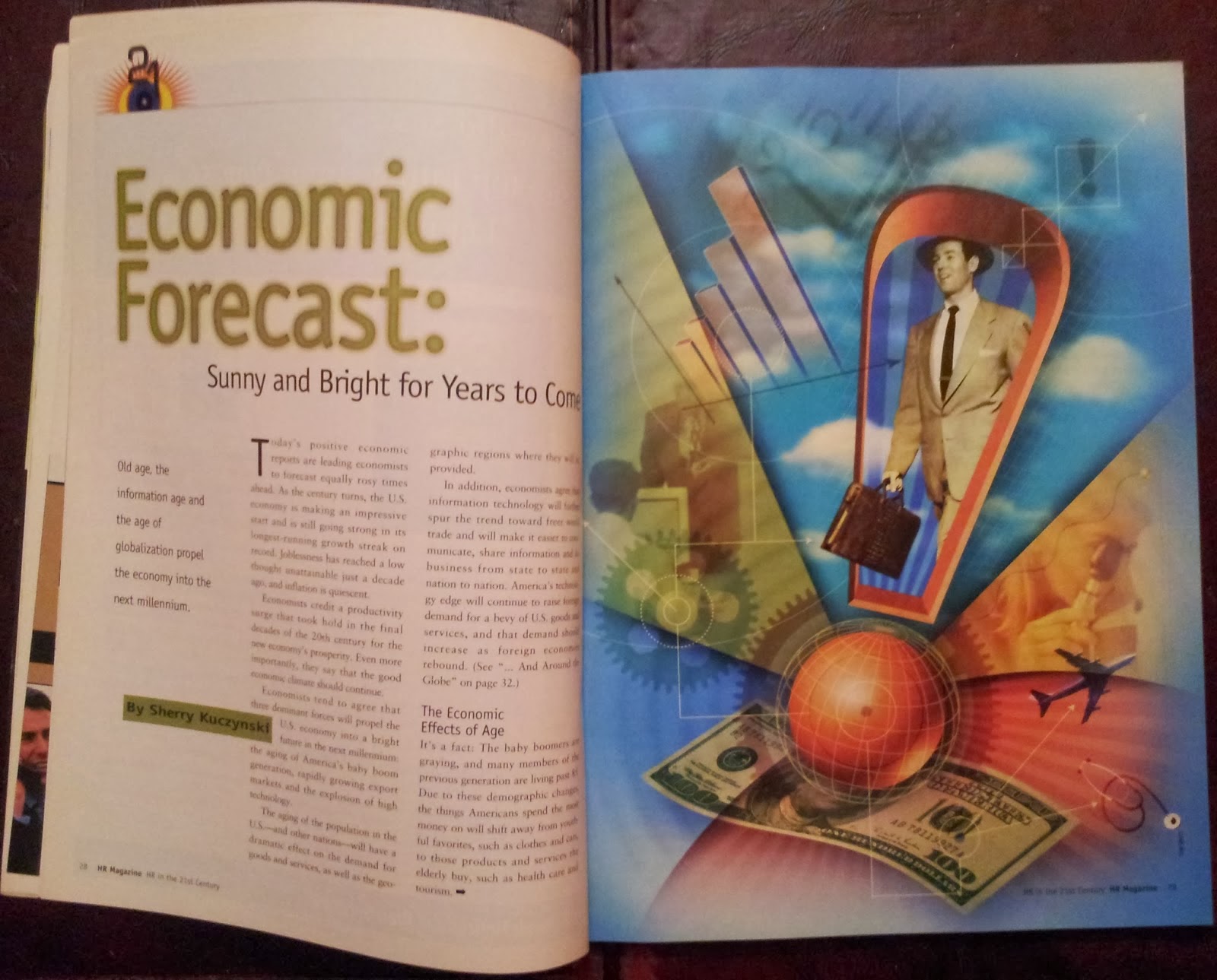
I was cleaning up the office that I use when I work onsite for one of my clients when I came across a stack of magazines. They were from HR Magazine, which is published by SHRM, the world's largest Human Resources association.
I love HR, but does anyone else?
It's been a while since I saw one so I started looking through them. And then I saw this one:
A collector's item, perhaps?
It's from 1999. Wow.
You can't see it in this picture but there's more to the headline than just "The 21st Century." At the bottom it states, "What's in Store for HR?"
Inside, there are various articles, all attempting to answer the above question. The contributors discuss the different generations in the workplace. They attempt to interpret the potential legal, technological, and economic landscape that Human Resources practitioners may find themselves in. Advice is offered on how HR and business leaders can best prepare themselves for these changes. 
The future's so bright, I gotta wear shades...
As with any attempt to peer into the future, some of what's discussed seems to be an extrapolation of (then) current information. For example, the idea that when Baby Boomers retire it will potentially bring about a shortage of skilled workers.

"From 2000 to 2020, annual unemployment rates fluctuate between 3.5 percent and 6.5 percent, averaging about 4.7 percent."-quote from an article within the 1999 HR Magazine

Back in 1999 I wasn't a HR professional yet. I wasn't focused on the future. My mind was on the present, which consisted of bills and building a relationship with my future wife. Oh, and the Y2K scare.
Were HR/business leaders at the time looking ahead? Were they preparing themselves and their workforces? And could anyone have predicted the last 14 years?
  • Terrorism
  • Global Recession
  • The rise of the global economy, particularly Brazil, Russia, India, China, and South Africa (the BRICS)
  • The United States electing its first African American President
As we've seen, the future is chaos. While we can get some things right, it's impossible to figure out completely. Regardless of how we may feel about the events that have shaped our current reality, it's important to never stop looking to and preparing for the future. We owe it to ourselves, and to those we impact.

How are you preparing yourself and your workforce for the future?


Friday, December 13, 2013

Blame It On the Rain

Deflection is an art.  We can really get great at showcasing our ability to deflect responsibility and avoid consequences.  In my life, I have known people who were great at this.  Some might even say I know how to do this well.  Perhaps they are right, but it seems to be such a requirement in the workplace that likely I've adopted methodology.

Remember when Milli Vanilli were caught lip-syncing.  And then we found out they didn't sing the songs that they won Grammys for.  And then they were embarrassed.  And then they blamed the record company.  And then they blamed the pressure to succeed.  (And then they released a demo of them actually singing? Just awful, by the way)  Lots of blame being tossed around. 

And why?  Why is this the norm?  Maybe some of it comes from the overbearing nature of some moms and dads (it's always about mom and dad, isn't it?).  "Little Jimmy" could do no wrong in school ("it was that lousy teacher"), in sports ("the coach never gave him a chance") or in his first job ("it's the summer and they wanted him to work 8 hours in one day...the nerve!").  Mom and Dad could have meant well, but instead shut off the ability to fail, to stumble, to learn from his/her mistakes.

Maybe it's because our society doesn't want to hurt anyone's feelings.  I work with many companies that are corporately held in another country.  When those CEO's engage with US workers, they notice how quickly feelings are hurt.  It's an oddity to most of them.  Are we too sensitive?  Maybe.  I mean, just because I still cry at the end of every repeat episode of Touched By An Angel doesn't make me sensitive, right?  But I digress...

It's not unusual for an employee to blame another employee or a process as the reasons why something didn't work or why he/she was unable to complete a task appropriately.  There may very well be truth to what that employee shares, but does it excuse the employee from getting the job done?  Some companies that have stagnated find themselves making excuses along with employees as to why things aren't working.  We think that more policies, more parameters, more rules, more goals, more more more will motivated change in process, in employee attitude, in results.  OK, America, how's that working out?

If you don't like that your employees do it, have you checked to see if they are learning by example?  Of course, this is not going to be the case in all situations.  There is some tough love needed with some employees.  They need to know that it's not okay to just wait for everything to be fixed before they work harder, smarter, better.  They have to be accountable to their performance.  If something is not right, what have they done to bring it to the right channels or, even more so, to try to correct it?  We want to encourage innovation, critical thought and a healthy work ethic.

But sometimes, as I said, the company leadership has fallen into an excuse-laden mode of operation.  Once we find the right people, things will get better.  Once the new product line is tested, we will start to make money.  Once the economy changes, we will be in better shape.  I cannot tell you how many CEO's have said or thought that a new political party in power would change everything.  It's not Bush's fault your company isn't working out nor is it Obama's fault.  Of course there are things we wish they had done differently to help US companies, but regardless, it's the company leadership's responsibility to make things work in the context of what is, not in what's wished for.

Survey the environment, study the competition, take financial management courses, work with experts...do whatever it takes to make your company great.  If you are a business leader, take that role seriously and expect it to be hard.  If you are an employee, figure out ways to make your job work the way it ought to so that you can achieve the results expected. 

For all of us, life is not about waiting for things to work out.  You probably won't hit the lottery.  You probably won't retire at 40.  You probably won't get your way in everything.  So what does that mean?  Blame?  For our company?  For our spouse?  For our children?  For our parents?  Really, think.  What does that get us?

Be committed to excellence, not blame.  Be willing to own what you are not doing well and then decide to change.  Seek help.  Seek collaboration.  Seek ingenuity.  We're much better than blame.  Divert those energies into something remarkably positive.