Showing posts with label knowledge. Show all posts

Wednesday, October 5, 2016

More Than Words

Rating people is tough when you've got to put it on paper.  It's one thing to talk about someone, especially when behind his/her back.  So-and-so stinks at such-and-such a task.  But if you're in charge of reviewing someone, those words matter as they translate onto a page.  Ask yourself about context as much as content.

When Lucy and Ethel go to work in that classic chocolate-making production episode, their rating was pretty poor.  They over-exaggerated their abilities, they could not keep up with the line, they ate product while working and they tried to cover up their errors.  They were fired on their first day.  

From a television rating perspective, this episode started Season 2 with a bang.  It capitalized off of the ground-breaking work of the first season and set the tone for television sitcoms for decades to come, to this day.  The ratings for their work was at the highest levels.

So how do you give thought around context in order to frame the content?  A relevant evaluative process is more likely to give credibility to the results in the eyes of the employee, even when those results are less than excellent. 


Tactical - What is the hands on level of engagement into the organization's health?  Look at how the employee puts his/her time and talents into the company.  And, then be able to point to the result of such tactics.  Is there an organizational influence?  And while business bottom-line is the easiest metric to use, it limits our view.  For example, a survey might reveal that most employees feel comfortable in the workplace.  Find out why.  It may be because the front desk receptionist greets everyone warmly and genuinely.  It might be that he/she acknowledges others specifically for achievements, birthdays, tough times, etc. That person contributes to organizational health, despite the lack of a straight line to net profits.  That person has a line.  Look harder.

Experiential - How has the employee involved himself/herself in the company?  What have they experienced, either voluntarily or involuntarily?  Consider both causes.  Just because someone volunteers to do something, doesn't mean it was good for anyone involved (and yes, you can fire someone from a volunteer role...).  Maybe there are new processes initiated by an employee's willingness to try.  As such, they've been added to a workflow or perhaps replaced a previous workflow.  But just as important, maybe an employee rallied his/her department to participate in a walk for a particular disease-fighting organization.  Those experiences should not be lost if they don't fit into a clean bucket for the company's review pattern.  Go back to considering what those experiences have done for the organization.

Emotional - Odd, right?  We have so many emotionally-stunted people working in our industries that it's important to think through this.  Listen, hugs and kisses aren't what's really meant by emotional (although, I have been a good receiver of that type of love for years...don't stop!).  Emotion is tied to communication, critical thinking and behavior.  Do they not matter in a consideration of performance?  There is a great deal of teasing regarding millennials and their lack of consistent approach. "There's a stop sign ahead, but if you don't feel that the stop sign applies to you, then do what you think you should do.  Don't stop if you don't feel you should.  It's okay."  That perspective is not exclusive to one generation.  I still talk to some 60 year-old business executives who haven't figured out emotional health and they struggle to connect well with staff.  That's not good for business.

Social - How has community been fostered by this employee?  So many companies talk about how they're a family.  That invokes an employee's context about family.  What if my family is a bunch of narcissistic, inconsiderate, selfish jerks? (This is just an example, it's not a reflection on anyone in my family so please, Mom, don't text me and send me angry-faced emojis).  The consideration should be about fostering supportive, interpersonal relationships for the movement of the organization and for the building up of others.  Look at how an employee engages with his/her teammates.  Speak to dynamism, collaboration and group ingenuity.  That takes risk for each employee willing to be engaged at that level and we should be mindful of that healthy impact.

Of course, I know, that you have a performance review form that has many more areas to consider. But maybe, those other areas should be considered in this expanded context.  Haven't you heard, "But you don't know" from employees defending themselves from a manager's perspective?  Sure you have.  So, why is it that we don't know?  Looking holistically as well as specifically takes time, I get it, but it's the best way to consider talent.

Quite frankly, we don't have an never-ending supply of ready-to-wear talent. This type of consideration will enhance how we can better setup our staff for success through skill development, knowledge management and attitude improvement while reducing our turnover.  

If your manager sat with you to review your performance and began to share a limited view of your impact, you would want to say, "But you don't know."  Think about your staff saying that to you and be ready to offer the fuller context in light of the above areas.  Let them know that you do know.


Thursday, October 8, 2015

The Boss

Managing people is a skill. Yes, there are attributes that come easier for some which allow them to manage easier, but the use and refinement of those attributes is what makes it right.  The guilt some feel about not being a good manager is often a result of comparison to one of these “naturals.”

Are you a natural?  Do you find yourself easily speaking with your team?  Do you find that there is an ability to connect with people that just flows from you?  That’s wonderful! But, it doesn’t mean that you’re managing people.  It could mean that you are a great friend, a great listener, or a great motivator, but it doesn’t mean management is natural.  Being the boss is meant to be categorized by effectiveness, best use of talent and profitability, to start, not merely being the "fun" manager.

Think about a boss you’ve had that you liked. Perhaps the reason you liked him/her is because of the great manner with which your department was led.  You liked that he/she took the reigns, presented as a resource for the team and kept everyone focused on the mission.  You like that.  You crave good direction.  You desire knowledgeable people to take seriously their role.  Perhaps.

Or perhaps it was because you connected with him/her relationally.  You had common interests.  You shared a passion for sports, for a hobby or for beer (maybe beer is a hobby?).  You got to know each other’s families.  You shared time outside of work being social.  Did that make the person a great manager?  Or merely a great friend?

I am not suggesting that every manager become a Miranda Priestly and remain clearly unfriendly and distant.  However, I am suggesting that swinging the pendulum too far the other way might make managing just as a difficult.  Hone in the skill sets needed to manage effectively and use those skills as you rally your team together.

Time – There is a skill involved in planning and in the usage of time.  If you are someone that just lets things “get away from you” then you aren’t managing.  Time needs to be managed.  Haven’t we all looked at the clock during the work day and thought, “How can it be 3PM? I haven’t gotten done what I needed to today.”  Be competent in time management and help your team to pursue a similar goal.  Efficiencies to process are certainly business-centric and are worth the effort.

Material Knowledge – What do we make, how do we make it, why do we make it.  If it’s a service-related industry, follow the same pattern – what do we do, how do we do it, why do we do it.  You’ve got to know this backward and forward, and be able to translate it well to your team.  They will look to you to see how seriously they should know the answers to those questions.  If it’s just a job for you, then don’t be surprised when it’s just the same for your team.  Be passionate about the ingredients, materials, resources used to get done what you are tasked to get done.

Communication – “Hey, Bud, how ya doin’ today?” should not serve as the moniker of your relational investment.  What does that communicate?  Likely, you are a necessary person in my life and I can’t avoid it.  Intentionality in communication is necessary.  Plan what needs to be said; don’t hope you remember.  Know what and why things have to be shared, the time it will take to do so and the opportunities for that communication to be collaborative. 

Of course, there are more elements than this, but deciding to become proficient in these areas will certainly impact the team being managed.  Once there is a mastery in skill development and process, then begin to attack the next step.  It will become second nature.

The effort matters.  A manager who is deliberate in seeking to refine those skills or to develop new ones sets a stronger tone in his/her department right away.  Your staff will recognize that you’re not there to be everyone’s best friend, but to be a developer of talent by taking seriously your own development.  It also communicates a belief that not everyone is a “natural.”  It’s okay to work at it.  Think about the impact on the team you lead if they see you studying, practicing and exercising these skills.  You will be encouraging them to do the same in their areas of functional responsibility and soft skill development.

There were many days were I would have liked to do a “Devil-Wears-Prada-Throw-My Jacket-On-The-Head-Of-An-Employee” moment, but I didn’t.  I had to make the decision that the proactive development of my management style would be compromised by either creating a too-friendly demeanor or a too-mean demeanor.  So, hold onto your jacket as you walk in and hang it up yourself!


Wednesday, May 6, 2015

(You Better) Think

"Looking back, the thing that's really impressive is that here were these leaders running the Civil War, and people...had time to meditate on the day's events...They weren't multi-tasking; they had time to reflect. It's a luxury many leaders just don't have today, and that's a real loss."
The above quote is by Doris Kearns Goodwin, author and historian, in the April 2009 edition of the Harvard Business Review. The entire article is great and this quote struck me in particular.

I'm a knowledge worker. My job involves utilizing large amounts of information and making decisions that support the goals of the organization I work with. Some are straightforward while others requires a fair amount of analysis and consideration.

When it comes to strategic initiatives, it can be all too easy to go with what worked in the past, without considering how it may impact the present. This is where the danger lies. Considering the fast paced world most of us live in it's important that we take the time to reflect on what we do and did, both professionally as well as personally.

It's also important that these reflections be recorded. I know that sounds obvious but think about it--how much of your organizational member's unique knowledge is accessible--to other staff, vendors, and partners?

For example, in a former role I managed the annual update to the employee handbook. My partners and I made policy decisions that impacted thousands of employees. It was also my responsibility to communicate what changes had been made and why. Part of the strategy in accomplishing this was by saving the previous drafts of employee manuals that were created over the years, along with a supporting notes and communications generated. As a result, we became much better at determining which policies were effective and which weren't.

Having these reflections on record also help to preserve and perpetuate an organization's unique culture, which is often underrated and should not be taken lightly. I know that many people argue that a job's a job, but all things being equal, people tend to choose organizations that reflect their professional or personal values.

Another way to look at it is like this--if your top talent got killed tomorrow would their best practices, leadership decisions, etc., die along with them? It's morbid, I know, but I'm trying to make a point. This is why when Steve Jobs took a leave of absence in 2009 people started to wonder if it signaled an end of an era at Apple (as well as rattle shareholder confidence). When employees who represent the best of a company's values and vision leaves it can have an effect on morale and productivity. Preserving their output for others to access helps to minimize the loss of critical resources.

Here are a few suggestions on being better at self reflection:
  • Set aside (idle) time for yourself. Too often we use what little free time we have to do more stuff. Give yourself time and permission to do nothing, within reason. And stick to it the same way you stick to your other commitments.
  • Stay healthy. Numerous medical studies show that a good diet and regular exercise have a positive impact on brain functions. It also helps with stress management, making it easier to think more clearly.
  • Write it down! This is the one I struggle with the most. I'll have a great idea and by the time I'm ready to implement it I've forgotten the most crucial elements (Doh!). So now I carry around a pen and a notepad to jot things down in the moment. It damages my street cred but it preserves my thoughts.
  • Promote and utilize collaborative tools within your organization. Wikis, blogs, and intranets are some of the tools that may be used by organizations for capturing its members knowledge. It's important that they're easy to use and are supported by top management.
  • Share. Aside from colleagues, you should try to speak with those outside your normal comfort zone. Remember, you're responsible to all stakeholders. Being able to effectively explain yourself to them (and vice-versa) will only benefit you.
If you want to continue to make quality decisions then take the time to reflect and share this insight with others. Without it you could be missing important opportunities for yourself and your organization.


Wednesday, April 8, 2015

Don't Fear the Reaper

Go to @twitter and search for #leadership and plan on spending the next four days with no sleep reading what’s there.  Oh, and that won’t give you enough time to finish.  We are a leadership-sensitive business community.  Books, articles, chats, posts, etc. are aplenty regarding the need for, the stability desired in and the call for leadership.  It’s needed in business, at home, in our houses of worship, for our town little league programs, for our school boards and beyond.

The marketplace is ravenous for leadership-directed material.  I have been known to write about it.  I have been known to coach leaders on leadership.  I lead one of the premier HR consulting firms – Humareso.  I like leadership.

Sadly, however, over the past decade, I hear many complaining that our need for leadership is thwarted by a lack of desire for people to step into leadership.  Let me be clearer.  We’ve all experienced leaders who had no business being in positions of leadership.  They were cruel, cold, uninspiring, lacked vision or narcissistic.  Many couldn’t manage their way out of a paper bag let alone lead anyone anywhere (ok, so I have some strong feelings about bad leaders, I know).

Perhaps because of those bad leaders, we have many who could perform the role of leader who won’t do it.  They’ve seen the bloody battle that erupts around leaders.  They see the accolades, sure, but they see the bathroom wall writing, too.  It’s a reputation-killer in our society to be a leader.  Can we honestly blame people for not wanting to lead?

Or perhaps it’s Marvel’s fault.  We hold up high the myth of the super hero who can come in and lead effectively with character and right action.  Those movies are blockbusters, but do they set us up to think that all leadership should look like Captain America?  It’s a fantasy.  Could it be that our fascination with that genre impacts our willingness to jump into leadership?  Could be.

So what do businesses do?  They are so starved for leadership that money and willingness become tied together.  Begging someone to lead and paying that person handsomely is our charge to motivate.  I agree that our leadership should be compensated for the skill sets, aptitudes and knowledge they possess.  However, if we bypass those qualities in favor of willingness to hold a position, we belittle the intention of leadership.  Instead of influencers towards mission, we box bodies into short-term, high-paying figureheads.   That doesn’t seem too appealing. 

If someone has some of the qualities necessary to build upon for a leadership role, it’s our job to help coach them into the role, not scare them off.  Promoting people because you can is not a successful succession plan.  True leadership is of a different path.  Leadership is about influence, yes, but deeper than that, a leader inspires others to push and reach for their excellence individually and corporately.  A leader rallies people toward a challenge or lasting goal.

One of our passions is to ridicule and belittle our leadership.  We leave them little room to grow from their mistakes.  The title of leader does not and should not imply perfection.  No one fully arrives once given a role like that.  Regardless of your political persuasion, look at the way we’ve beaten up our last six presidents (and please, don’t send me any articles as to why Bush or Obama or Clinton are more awful than others).  I wouldn’t want any of my kids to be president, and that’s a sad statement.

If I were president, I would receive a barrage of criticism just like they did.  And while that’s on a grand scale, the smaller version is just as powerful in our workplaces.  It’s why we struggle to find people willing to step up.  And so our succession plans move from who is able to who is willing.  There is a vast difference between the two.

Some of you reading this know I am talking to you.  You know that you have the ability to lead, but won’t jump in.  You’ve seen how other leaders have been devoured by their own.  I know it’s not pretty.  Leadership, however, is a privilege that costs.  It’s not that you will become a leader and now be free from ridicule because you’ll have them read this blog.  That’s not what will work.


What will work is your relentless pursuit of excellence, your drive to encourage those you lead towards the mission and your creative exuberance towards the vision.  Some will not like to see this type of person leading them.  It’s too active, too forward thinking, too expectant.  I would say that’s too bad for them.  You are made from deeper and richer stuff.  Don’t fear leadership and what might come with taking it; rather, fear what a lack of leadership will do for a spirit such as yours. 


Wednesday, March 25, 2015

How Can I Be Sure?


I get approached regularly with requests for career advice. I get asked all sorts of questions but they tend to be variations on the following:
  • How do I break into Human Resources?
  • How do I use social media to build my brand?
  • What help can you give me to find a job?
  • Victorio, why are you so cool?
I admit that the last one, while my favorite, is false! The others aren't.

I can sympathize; I've been in that position, one where I felt clueless about an important question I needed answers to, or a choice that I needed to make. As a result, I do my best to help people out. Usually I start with an email exchange and then if they're comfortable we'll move on to a phone conversation. If they live or plan to be in New York City then we can meet in person. Through this process of communication I've helped people figure out next steps in their professional lives, as well as developed some great relationships.

As I mentioned, I've felt clueless. I still feel that way sometimes. I don't have all of the answers, nor do I want to. Having challenging questions to answer is part of the learning process as a professional. For me, it drives me to better understand and articulate my passion for Human Resources, along with how I can support my clients in the best possible fashion.

I also recognize that, while I consider myself smart, capable, and creative, I'm not the smartest, most capable, or creative Human Resources professional in the world. As Bill Joy, computer scientist and co-founder of Sun Microsystems, once said:
“No matter how many smart people there are within your firm, remember that there are far more smart people outside your firm.”
It's important to remember this. Even if you yourself are an expert in your respective field, there are others out there just as capable, if not more so. And in this era where top talent and resources can be accessed from almost anywhere, it pays to recognize when to reach beyond your known environment for advice and expertise.

This is part of what leaders do--gather intelligence, as well as assess its quality and relevance to the issue at hand, in order to make informed decisions. Without the ability to ask, as well as the willingness to reach out to those within and outside a person's comfort zone, people may not have the relevant insight, perspective, or information necessary to make good decisions.

Competitive advantage can come from timely access to information and expertise, not necessarily being the source of it. Approaching people for help isn't a sign of weakness, neither is asking questions. When done correctly, it demonstrates an ability to seek out and make quality decisions based on the best information available.

How do you ask for help?


Thursday, October 9, 2014

Got 'til It's Gone

“Noooooooooooooo!”  That shout when one of your key employees gives his/her resignation.  Two weeks, of course.  Confusion, fear, frustration and panic set in.  What will we do?  Why is he/she leaving us?  Who is responsible for making this person quit?  Let’s find that person so that we may substitute one separation from the company with another!

It’s no fun, but it happens.  Besides the knee-jerk reaction, there are important questions that should be asked:

1 – What led up to this person’s departure? – There were warning signs, even subtle ones.  Longer lunches to perhaps squeeze in an interview?  Wearing nicer ensembles to work? A definite change to communication patterns?  Less willingness to do that little bit extra?  Think back.

While reflection may not change the outcome, it is important to become better at identifying the signs for the future.  Being oblivious is not okay when it comes to talent management.  In the full picture, it’s critical to manage your talent effectively, which includes observation and action.  Asking yourself, “What should I have done?” is fine, but asking, “What can I do now?” is better. 

2 – How effective has support and accountability been? – Odd question, perhaps.  Truthfully, it’s often the case that someone leaves because he/she feels like so much work and effort has been done by him/her without reciprocity from other team members.  Accountability keeps everyone honest.  It also keeps dialogue going regarding areas of drop-off.  Support and re-structure can be offered once those details are known.

3 – How will we get the knowledge about processes, systems, compliance, etc. out of his/her head and into someone else’s in the organization? – I often joke with a new employee when introducing him/her to a seasoned veteran of the company that the veteran has probably forgotten more than the new employee will ever know.  There is truth to this, though.  If someone has been with the organization for years and is truly a key employee (not just dead weight that has been allowed to fester for decades because no one is brave enough to do something about it…ouch!), then the knowledge along with the nuances of history are hard to replace.

Effort needs to be put into mentoring and coaching opportunities regularly.  To try to get all of the knowledge out of someone’s head who just gave his/her two weeks’ notice is silly.  It won’t happen.  By establishing it as a normal business practice avoids panic and an unreasonable  burden of “data dump” between the leaving and the staying employees.

4 – Is the position needed? – Nothing says “Don’t let the door hit you….” then when you realize you haven’t needed that role for some time and have no intentions of filling that role.  But it’s true!  Out of our busyness or sheer laziness, we haven’t looked at role effectiveness.  Perhaps a resignation is a gift (for a variety of reasons, I know) in this vein because we can be forced to look at structure and process.  Does this role push the mission for the organization?  Is there overkill in the management level of the org chart?  Or, the real kicker, measure the results of that position.  If it’s not acceptable, was that because of the person in the role? Or because you don’t need the role?

5 – What will the ripple effect be, if any? – “Who’s with me?” For those of you who’ve not seen the movie “Gung Ho,” watch it.  Besides the datedness and the stereotypes, it deals with productivity and cultural issues.  A rallying of the troops as a result of someone leaving can be crushing, of course.  Walk outs or just a couple more resignations can affect morale deeply.  Repair won’t be overnight.

Proactively engaging a couple of layers of managers and directors will thwart one person from having such power.  Even if a key employee leaves, the communication channels would have been open to more than merely that supervisor.  If I can approach my manager, my director, my CEO as well as my team, then the departure of that manager won’t seem as “end of the world” as if he/she was the only superior who knew I existed.  Be visible, be communicative, be real.

Overall, it’s wise to care for all employees.  It’s very wise to care for those key employees.  Know what they need.  Know why they need it.  Know how support can be given.  BUT, measure effectiveness, too.  We’re not prisoners.  We don’t have to be held hostage by a key employee.  Figure out why and how to get the information out of his/her head and into others’ heads.

And to be truthful, a healthy resignation can do wonders for a company, too.  Jus’ sayin’.


Friday, May 16, 2014

Video Killed the Radio Star

When I was a kid, my mom used to laugh at me because I basically had the TV Guide memorized about 10 minutes after we got it.  I would know what shows were coming on which day, which shows were new and which were repeats, and even which celebrity guest stars would be on Match Game.  To be fair, there were a lot less channels than there are now.  And further, I didn’t have much to do apparently, so memorizing the TV Guide was easily done.

I loved TV.  I guess I still do, though I watch much, much less than I did as a kid.  And I could not tell you the last time I held a TV Guide in my hands.  So much has changed in that medium.  I wish I knew then what I know now about how it would evolve.  It would have been great to be at the forefront of the development.

Our brands need the same care.  What are our brands?  I think there are a few to pay attention to:

1 – Our companies – The brand identification for our organizations matters.  What does the public perceive about your company?  What is the messaging?  What is it they think of first when they hear your company name?  Those answers are a matter of our brand.  Do you know those answers?  How do you know them?  In other words, how were they communicated to you?  Companies spend millions on marketing their brand, but can still miss the fact that the messaging is misaligned from the actual company.

Branding is not marketing.  Branding is about the utilization of the brand; it’s about the prep work done ahead of the marketing to the public.  Sometimes, companies think that a snappy logo is the brand identification.  The logo is really more about marketing than branding (See Phoenix Cavalier’s thoughts at http://biznik.com/articles/branding-is-not-marketing).

2 – Our roles – There is perspective held by those around us of our jobs.  A role may be seen as tactical or strategic.  The position we have now may not be what we want for our future, but because the role is seen as one type of position, it can translate to what others might think of what you can do.  If the role you’re in is not strategic, but you want that opportunity, then re-branding it is as strategic is necessary. 

Think about the positions in your company that have been changed or discontinued.  How did they become irrelevant?  Is there danger of that for your role?  I worked for a company that saw a particular role as irrelevant and therefore discontinued it.  About three months later, there was so much not being done that the short-sightedness was glaring.  One VP commented, “I had no idea how much that role actually meant to the function of the department.”  The brand of the role was not clear.  A brand is simply the message of a product, service, or, in this case, a position.  Again, what’s the message of your position to the company?

3 – Our competencies – If a role is to go away, are you going to be swept away with the position?   Can the company see the difference?  Your skills, knowledge, aptitudes and abilities have a message.  Step back for a minute and see if you can read what they are saying to those around you.  If you’re feeling particularly brave, ask someone if they could give you 3 skills that he/she sees you demonstrating on a regular basis.  Vulnerable, yes, but it could be quite eye-opening. 

When the makers of the TV Guide magazine product imagined their brand, they could only see it as a publication distributed on a weekly basis.  As time went on, it provided interviews with TV stars.  And once the necessity for a weekly magazine became less relevant, TV Guide moved to creating a TV channel with entertainment news, syndicated shows, reality-based programming and showbiz interviews.  The core brand evolved to a fuller spectrum of TV entertainment. 

Check your brands.  What’s the message?  Oh yeah, by the way, if it’s to be a good-looking, Italian, HR pro with a dynamic consultancy and a killer blog who is trying to influence the business community with strategic development encouragement, I’m sorry to say that’s already taken.  Back off and pick another.


Friday, February 7, 2014

Candy Everybody Wants

SMH.  How cool am I?  I know that SMH means “Shaking My Head” in text and social media chat.  OK, you might not think I am that cool, but I do (and isn’t that all that really matters? Ok, not really).  We do know that just because you know the latest slang, technology or fashion doesn’t make you relevant.  Relevance comes from true engagement.

OK, what the heck does that mean?  Sounds like the latest talking point for me to use as a keynote.  I can travel from SHRM Chapter to SHRM Chapter and sing the values of true engagement.  “For only $39.95, learn all of the secrets of true engagement that will transform your business, your marriage and your life! Act now and I’ll throw in a Ronco Potato Peeler absolutely free! (Just pay shipping and handling)”.  Nice, right?

True engagement is about connectivity.  For business-minded people, this means connection to competition, market conditions, market changes, talent trends in skill sets and training, strategies around retention and succession planning, etc.  I will be relevant when I am relevant.  I don’t look or sound relevant alone; I am to be relevant in what I do, too.  Often this requires an investment in time to determine where my resources are better spent moving forward.  I assess situations, weigh the facts, research what I don’t know and make decisions.  This screams of relevance.

As people, we yearn for connection to others, to ideals, to purpose.  When something is out of line, we seek to find a replacement for what’s missing.  One of my recent favorite actors died this week.  Phillip Seymour Hoffman could draw you in to the role he was playing.  You believed it was real.  You tracked with him.  You could connect with the performance.  Out of the limelight, he struggled with the same things we all struggle with – relationships, meaning, direction.  What he ran to for answers did not provide what he was ultimately looking for, but don’t think he’s alone in that.  I am not speaking of drug use, but on a grander scale, running to something easy to fill the deeper.

Our relevance is not bound to coolness.  When I sit and listen to someone pushing a book about how to be relevant to Gen Y, for example, I could get up and punch them in the middle of their speech. (I mean, slap them, ‘er, rather, give them a stern glare…ah, that’s more HR).  Tell me how to measure competition better, how to measure and read financials better, how to discover better talent and recruit more effectively.  That’s what will make me relevant to the workplace, not a Blu-ray in the breakroom or $5 Starbucks gift cards on an employee’s birthday (OK, I don’t really mind that one, but…). 

Your connection comes from putting yourself in places to be connected.  What are you spending your time on?  Is it profitable?  Is it bottom-line driven?  We are so much better than flash and glitz; we are substance.  Our purpose comes from pursuit of such things; work to fight against those things that would distract us from our meaning.  We have depth.  We bring purpose to the table for others to share.  We are relevant to our companies, our homes, and our country when we pursue connection to real, lasting principles.  For our business communities, these principles must be foundational and returned to time and again.


There will come a time when I will no longer be able to physically pursue some of these things, and as such, my relevance may slip.  May I remain strong in my core to not become discouraged.  My mind may want more, but my body may hold me back.  But maybe, by that time, the Ronco Relevance Infuser will be on the market.  Of course, I will be first in line…SMH


Tuesday, January 28, 2014

The Future's So Bright (I Gotta Wear Shades)

Post by +Victorio Milian - Twitter @Victorio_M

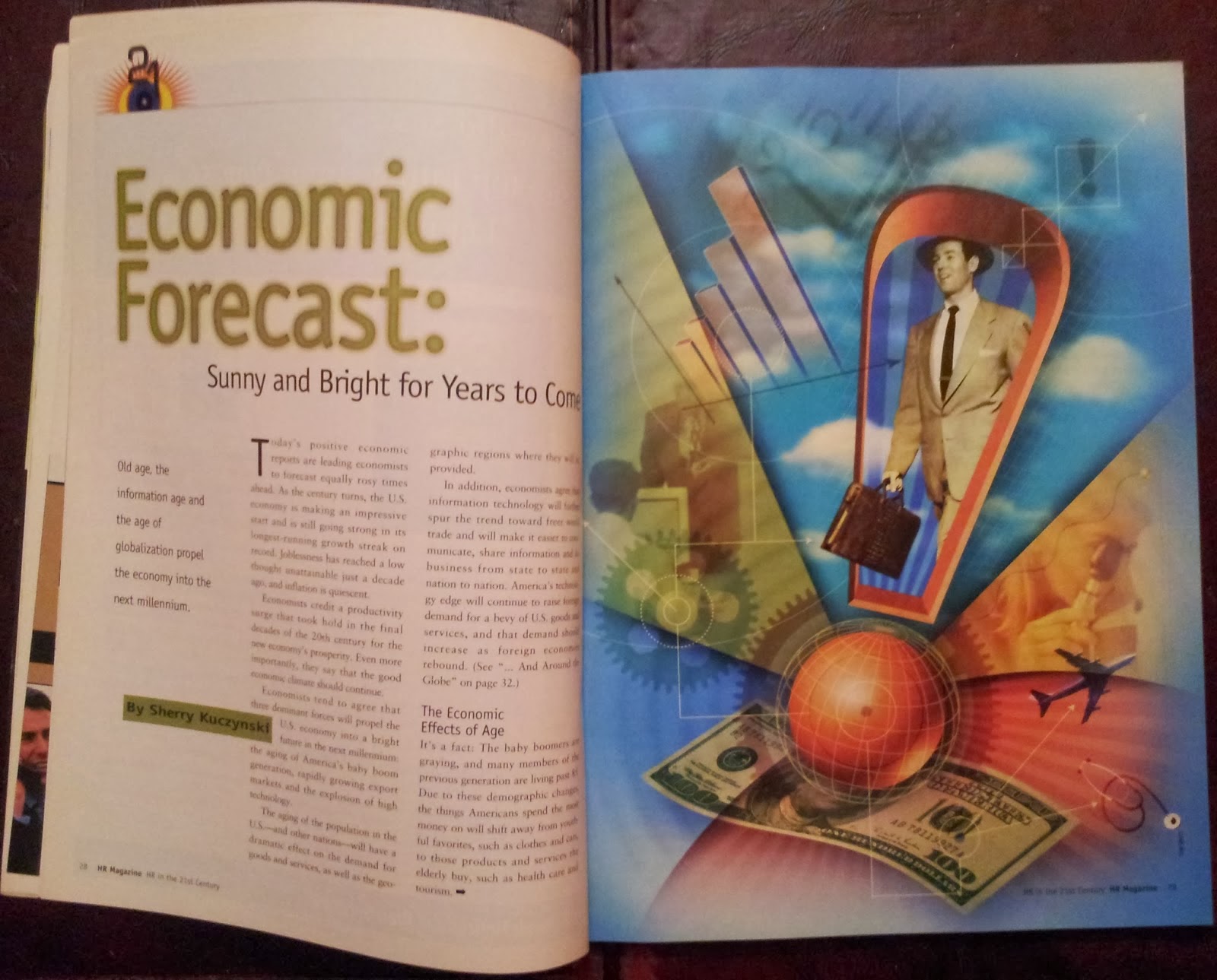
I was cleaning up the office that I use when I work onsite for one of my clients when I came across a stack of magazines. They were from HR Magazine, which is published by SHRM, the world's largest Human Resources association.
I love HR, but does anyone else?
It's been a while since I saw one so I started looking through them. And then I saw this one:
A collector's item, perhaps?
It's from 1999. Wow.
You can't see it in this picture but there's more to the headline than just "The 21st Century." At the bottom it states, "What's in Store for HR?"
Inside, there are various articles, all attempting to answer the above question. The contributors discuss the different generations in the workplace. They attempt to interpret the potential legal, technological, and economic landscape that Human Resources practitioners may find themselves in. Advice is offered on how HR and business leaders can best prepare themselves for these changes. 
The future's so bright, I gotta wear shades...
As with any attempt to peer into the future, some of what's discussed seems to be an extrapolation of (then) current information. For example, the idea that when Baby Boomers retire it will potentially bring about a shortage of skilled workers.

"From 2000 to 2020, annual unemployment rates fluctuate between 3.5 percent and 6.5 percent, averaging about 4.7 percent."-quote from an article within the 1999 HR Magazine

Back in 1999 I wasn't a HR professional yet. I wasn't focused on the future. My mind was on the present, which consisted of bills and building a relationship with my future wife. Oh, and the Y2K scare.
Were HR/business leaders at the time looking ahead? Were they preparing themselves and their workforces? And could anyone have predicted the last 14 years?
  • Terrorism
  • Global Recession
  • The rise of the global economy, particularly Brazil, Russia, India, China, and South Africa (the BRICS)
  • The United States electing its first African American President
As we've seen, the future is chaos. While we can get some things right, it's impossible to figure out completely. Regardless of how we may feel about the events that have shaped our current reality, it's important to never stop looking to and preparing for the future. We owe it to ourselves, and to those we impact.

How are you preparing yourself and your workforce for the future?


Thursday, January 16, 2014

Papa Don't Preach

“Make it work.”  I love this phrase.  It brings to mind those hard-nosed, over-working small business owners who are keenly aware of the limited resources they have.  They have little time for holding hands and for coddling employees.  In essence, “You can’t do it? Then get out” is the attitude.

The major metropolitan areas on the East Cost of the US that I have engaged with throughout my career (Philadelphia, New York, primarily) are full of small business owners.  Many first generation citizens built their businesses on the 24/7 principle of work ethic with little concern for how much PTO they’ve accumulated or if there is an ergonomic chair for them to sit.  They busted their humps and created an atmosphere of hard work above all.

And while I love this (work ethic matters!), I have also gotten to watch these family-run small businesses push their children into roles that they have little giftedness in or desire to do.  The guilt of what a grandfather and father have done to build a company sits on the son/daughter who is primed to take over, despite the fact that the son’s/daughter's talents do not lean towards running this business.  These conversations are very difficult for a son/daughter to have with dad; there is so much of a personal nature behind it.  A father might preach the painful story of how the business began and the work it took to build it.  Guilt can easily set in.  Ideally, the father will understand and support his child's choice, but often I have seen a dismissal of such a desire and a fatherly push to take over the company.

Perhaps it’s from this traditional thought pattern that some management holds hostage employees who need to go.  Companies can find themselves in the unfortunate circumstance of desperately keeping employees because of their knowledge of systems, processes or product despite their lack of cooperation with other staff or overall lack of connectivity to the organization’s mission.  The employee has shown that he/she is disinterested and demotivated, but because he/she has been there for some time and knows everything, we have to just deal with it.

Managers have encouraged, yelled, cried with and threatened these employees.  And to the detriment of some companies, some of these employees have been promoted through the years and now serve in leadership-type roles (supervisors or managers).  Why are these flakes promoted?  How is it that the apparent reward of knowledge solely over the full package of long-term connection is quality enough to promote someone like this?  Companies find themselves stuck to do this.  Well, get un-stuck!

Our places of employment are not Guantanamo.  We are not holding prisoners, but employing people (I know, some employees think the former, but don’t you believe them!).  If someone is not the right fit, then plans need to be made to transition this person out.  Employment at will is still a valid policy in the US and is allowed to be used, as long as it does not conflict with other legislation and policy.  So, set up knowledge-sharing opportunities so that those who you do see a future with can learn from those who should go.  The words here are simple, but the action of them is tough.  Managers think about the chaos that might occur when so-and-so is fired.  If our employees are not prisoners, then why is management?  The work-relationship is not about that.

If your father said, “you have to work this company and that’s final,” there is more to work through emotionally and relationally rather than just professionally.  In our workplace, most of our relationships are not familial.  We’re not disappointing two or three generations.  Management has a job to do.  Finding and keeping talent that will move the company forward is part of our responsibility, just as moving out that talent that is destroying or, at the least, stagnating the mission.  And to be honest, we’re not doing any favors to that individual employee who doesn’t fit.  Let that person discover what he/she should connect to in a new organization.   It’s okay; we’re not their father.


Monday, January 6, 2014

4 Minutes

Dynamic, collaborative relationships are desired.  Most companies that I get to work with are often eager to find professionals who understand how to make an impact with the skill set they have while being respectful of the authorities in place already.  Smart employers often seek to find these exceptional people with vigor.

So, where are these people?  Do they exist?  After speaking with some of the ones we get to work with at Humareso, I would say 9 out of 10 have become discouraged about the talent pool.  Whether it’s a non-committal attitude, a desire for a list of all benefits offered by the company prior to the first interview or an awareness that the depth of work ethic displayed falls short of what’s actually needed in the workplace, these employers have dejection written on their metaphorical faces.

People, let’s display what should be displayed, not just as an appearance, but as a true picture of the qualities we possess.  Do I think that all candidates fall into the descriptors above?  No.  However, do I think that these employers are wrong?  No.  They are responding to what they see.  And remember, what they "see" is not always viewable.

I sometimes wish that everyone’s skill sets could be viewed, such as what a model has to do for his/her interviews.  Show me what you can do.  You can sit all day and tell me how great you are, but it’s better when I see you get up and walk the catwalk.  The tangibles are visible.  How do you move?  What does your face do when you walk?  Do you capture the look we want?  It takes about 4 minutes to know.  So, theoretically, can you show what you must in 4 minutes?

Most potential employers conducting interviews say they can tell within a few minutes if you have what it takes.  So, if the interview is a half an hour or longer, what is happening in the interviewer's mind?  You’ve got to make a quick, competent impression as an applicant.  The shortfall here is part of the reason that these potential employers feel that there is a lack in the talent pool.  They struggle to know what you know because it’s not presented in a coherent way.  If you have four minutes, what do you want to share?  Practice.

OK, naysayers, I hear you.  “Yeah, but John, when I walk into an interview, I don’t get to dictate the questions.”  After years of witnessing interviews, I would have to say that more than half of those times begin with a potential employer asking one of the following questions to start out:
  • Can you tell me a little about yourself?
  • Why are you leaving your current employer?/Why did you leave your last employer?
  • Why did you decide to apply for this position?
  • Why should we hire you?

Think about what you can do with the answer to any one of these questions.  Can you give them a great snapshot of your competencies, personality and work ethic in four minutes by answering one of these first questions?  Heck, yeah (Sorry, I will tone down the language moving forward).  Practice what that response is.  Look in the mirror and work it out.

However, I have to address those who do practice the answer.  Can you act like you believe what you’re saying?  The words are not the only important part, but the facial expressions, body language, inflection and lilt in your voice, etc., too.  Robots are not attractive and will not communicate who you really are (unless you really are a robot, and in that case, please be sure to check “other” in the Self-Identification section of the application).  Being believable is done when you are believable.  Crazy, right?

Authenticity begins with a belief in who you are and a confidence in it.  You might not be a fit for every company, but you are a fit for a company.  Your disillusionment with the process of finding a job can be seen clearly in the first four minutes, even if you’ve practiced your answer.  The spark in your eyes is dim, the life in your voice is weak and the enthused body language is replaced by a slouch.  Be prepared, yes, but be engaged, too.

I do believe that the talent pool needs to get stronger in certain skill sets (technology, written communication and mathematics) and in presenting those aptitudes.  I believe it takes work to get the job you want to get.  I don’t believe that you should just hope it works out.  Rather, work it out.  Do what you have to do to be enthusiastically ready for an interview.  Share with those potential employers why it would be great to have you as an employee based upon a clear and vibrant expression of your competencies.  Believe in who you are.  You’ve only got four minutes.  


Wednesday, October 16, 2013

This Used to be My Playground

For 10 years, I have to admit, I have loved What Not to Wear.  I didn't really love Season 1, actually.  There was a different male host and the show was a little predictable.  But Season 2 turned the corner.  Men and women (okay, it's been all women for the last six seasons) with varying fashion dilemmas are nominated by friends and family for a makeover.  Seems classic, right?  In many ways, you would be correct.  So why with all of the other makeover shows that have come and gone, did #WNTW (oh yeah, I'm down with the hashtag) last for ten years?

In part, the hosts are hilarious.  Stacy and Clinton, bravo.  In part, too, it's because there is the understanding that the clothes don't make you feel something, but rather, who you are is highlighted by the clothes you wear.  Personality, professionalism and passion all pour through your outfit.  Silly?  What does it say to you when someone highly qualified shows up to an interview with ripped jeans and a graphic T?  Unless it's Urban Outfitters or a company in your mom's basement, you might be disappointed that this person did not think it worthwhile to dress accordingly.  Clothes do make the man (or woman, as it may be), but the tactic of #WNTW is to do so as an output of who the person is.

The hosts spend time talking to family and friends.  They ask the contributor what life has been like, where they want to go in the future personally, professionally, and how those around him/her can know those desires just by the contributor walking into the room.  It's not a clean shirt, trendy haircut and new lipstick kind of engagement.

We can do the same thing...not the wardrobe makeover part (I've seen what some of you wear and you're lucky there won't be an 11th year of What Not to Wear!), but a talent makeover.  Some of the issues for our long-term employees are that they've done work a certain way for years and it's tough to get them to try new ideas or new processes.  Perhaps they used to try and it didn't work out or the plans were too all over the place, so they don't "waste their time."  They have gotten used to playing on the same swing set and don't want to hear about the latest and greatest stuff.  It's very much like some of the contributors on the show.  They are still wearing clothes from the 80's and don't know why they can't get a date or that the dates they do get are psycho.  They're comfortable in what they know; "it's worked for me" is a common phrase.  

Let's show them how valuable their experience can be in light of new understandings of production, marketing and technology.  Let's get them into a new "outfit" not because we want to make them look hip, but because it will allow people to engage with them quicker and find out what they know.  Take the time to look at how things work in your place of employment.  Do the seasoned employees hang out with each other exclusively?  How will the younger ones feel okay to engage?  What about knowledge management?  What if some of those seasoned employees retire...where will that know-how go?

Assess the environment.  Not just the physical attributes, but the cultural attributes.  What is it the company values and how is that upheld?  Just like the contributor is encouraged to let his/her inner passions and interests shine through the deliberately chosen wardrobe, so too should our companies shine the mission and values through it's outer markings.  And that is largely seen in our employees.

We ought to be the experts at recognizing competencies in our people.  We should look for ways to accent and highlight those KSAs in ways that others in the organization will take notice and want to engage.  Think of it like dressing someone up for a date.  He/She may look good when they walk in the door and cause the date to be thrilled at the sight, but the conversation throughout the date will determine how likely this relationship is to continue.  So many companies have thrown thousands at image and surface tactics only to come right back to square one once the hoopla is over.  We know better than to fall for that (I hope).

The territory we're in charge of is our organization.  Allow talent to speak through our talent.  How can we facilitate the recognition of such talent?  How can we get our talent to go deeper and express more?  It's our primary job in human resources to manage talent fully (that's a lot of "talent" usage, isn't it?).  We don't get a $5000 gift card per employee to get it done, but we do get to use the resources at our disposal, which includes our smarts, to make it happen.


Wednesday, March 20, 2013

Life in One Day

We're in such a rush to grow up. When I was 9, I wanted to be 10. When I was 12, I wanted to be 13. When I was 14, I couldn't wait for 16, then 18, then 21. And then after 21, I realized that death was the next thing to look forward to (Don't even ask me about when I turned 30!).

Those new to the workforce feel a sense of "wanting to grow up." They look around and see experience in management and in some of the co-workers on their teams. They are acutely aware of what they don't know and are just as aware that there are even some things that they don't know they don't know (follow me?). I respect this. I am giddy with excitement at the future they will experience. I often express my eager hope for them and encourage them to enjoy the ride and take everything in. Have fun with it.

And then, it happens. A manager and an HR professional get together to discuss the learning plan for this new employee. And while I am a big believer in outlining expectations and encouraging learning, I have been known to take issue with the manner in which it's shared. Management and HR want this new employee to know how valuable he/she is. We express our happiness at his/her addition to the team. We smile. And then, our "engagement" dialogue begins.

I have been in the room for some of these learning plan discussions. What is to start out with a simple probe into what this employee has observed so far and where he/she sees some gaps that need to be filled turns into interrogation. "Vee haff VAYS of making hyu tok!" hangs over the employee as he/she gropes for some more answers to the thinly veiled question of "how much don't you know?" I have felt so badly for these employees that I have stepped in and encouraged a different question to be asked, or in some cases, have all but taken over the strategy meeting.

In a learning plan, the idea is to highlight areas for development and create strategies to engage education, modeling and practice into the plan. What we forget is that everything can't be learned tomorrow. We're so driven by results (which are important!) that we leave little to no room for development. Do you remember Kevin from Home Alone? His parents "accidentally" left him home for the Christmas holiday as the whole family headed to France. In their absence, Kevin felt the pressure to learn how to be an adult quickly and was very resourceful in doing so. In one part of the movie, he says, "I took a shower washing every body part with actual soap; including all my major crevices; including in between my toes and in my belly button, which I never did before but sort of enjoyed. I washed my hair with adult formula shampoo and used cream rinse for that just-washed shine. I can't seem to find my toothbrush, so I'll pick one up when I go out today. Other than that, I'm in good shape." And as the audience, we laugh because that's funny.  Is it so funny at work?

When our new employees rush to impress because they are already feeling the pressure outlined heavily in our learning plans, they run through a list similar to Kevin's telling of all the great things they've done. They are validating their role, their existence.  Sure, some of us would see these employees as brown-nosers or over-achievers, but worse would be labels such as lazy, unmotivated, or in some companies, the worst label of all - Gen Y (don't get me started!). As professionals, we have to consider our presentation of information as much as we consider the information itself. Learning objectives are valuable; continuing or establishing a learning culture is absolutely vital to competitive market strategies and to healthy employee engagement. However, when the delivery of those objectives is done in such a way as to make it "Hurry up and grow up today," pressure builds and insecurities for the employee rise to surface.

There is a real difference between expressing expectations and overshooting abilities. Some employees in some roles will need to acclimate to parts of their job first. Some roles are tough, some roles are multi-faceted. For some of these employees, this role may be their first real job after college. Don't you remember what it was like transitioning from wearing pajamas/sweats to class everyday to having to really get dressed for work (No? Just me? Awkward).

I recall one manager of mine who let me grow into the role. He laid out his expectations for me and peppered in often his belief that I would be successful in them. His confidence in me was a driver. His belief that the expectations he gave were things I would conquer, even if I couldn't see it myself at the time, was huge. He did not hand me the list and then heap on the "you better get this done" language. He allowed me room to use my personality mixed with my competencies to grow into the role...and to own it. He knew that I would and he didn't need me to get it all solved today.

Let's be really careful about how quickly we are asking our employees to master their roles. Do an assessment of what some of your most recent conversations were like. Own any language that expressed an overdue amount of pressure and forced maturity in the role, even if was unintentional. Allow those new employees to be guided with expectation, but not made grow up from 21 to 51 overnight. Embrace the talent you have today and encourage the greatness that caused you to hire them in the first place. Let the learning be seen as an everyday practice, not just during ramp up.

Use language to encourage while being clear in expectations. We want to have our talent set up for success, grow into their roles and be productive. It just shouldn't be forced to happen overnight.