Showing posts with label workplace flexibility. Show all posts

Friday, March 14, 2014

Bag Lady

(A post by +Victorio Milian

As a New Yorker, I use public transportation to get where I'm going. It's generally fast and relatively cost effective (especially when compared to the cost of owning and maintaining a car here).
Photo of Mosholu Parkway train station
It also provides a snapshot into how human beings act. Whether as individuals or in groups, commuters here speak quite clearly--through their behavior, dress, and other means--even as they avoid eye contact. One observation I've made over time is this: New York City commuters carry lots of bags. Now this is unscientific, but I can say on my normal commute to and from work most passengers carry more than one with them. The vast majority of multi-bag carriers are women. Based (again) on personal observation, most carriers seem to carry one bag for personal effects, and another contains essentials for the commute, such as gym clothes or work items (e.g., laptop, paperwork). 

For me, people carrying multiple bags present a challenge. They take up more room on the subway, which my main form of transportation. When you consider that close to millions of people take the subway on a daily basis, every available inch counts! In addition, I can't help but think that lugging that much stuff around consistently will have an impact on the carrier's health. If nothing else, it probably puts a lot of stress on one's back, shoulders, arms, and legs. I imagine that there's an enterprising chiropractor out there that specifically targets people impacted in this fashion. I know of one that has a sub-practice centered around clients who are in need, due to poor posture related to how they utilize their cellphones! 

With all of this, I strive to carry one bag with me when I'm out and about. Sometimes this presents difficult choices, but for the most part I can successfully balance my needs with my ability. I have bags of various sizes and shapes, and I also try to take care of myself so that, in the event of having to carry a particularly heavy load, I don't overdo it. I also try to carry items that perform multiple functions. For example, utilizing cloud based services such as Evernote, Google Drive, or Dropbox allows me to carry less paper files around. Because they able to be used across multiple devices, I can mix-and-match which ones I carry with me. Most days, this helps me to avoid carrying around my laptop, by far the biggest and heaviest of my work related devices. That being said, I'm overloaded in other ways. It doesn't necessarily manifest itself physically, yet it still can be exhausting. My issue is communication overload. Here's a snapshot of the various communication devices or channels I manage:
  • Two smart phones (one for work, one for me)
  • Several emails (roughly 1/2 dozen)
  • Fax machine (don't ask)
  • Two physical work mailboxes
  • Two phone landlines 
  • Social media outlets
There's a multitude of methods to reach me. And while it doesn't weigh much physically, mentally it can be a lot to manage and maintain. It demands that I check all these different methods, to insure I don't miss anything important. From a security perspective, the different programs and electronic devices I use means multiple access codes. It's a lot! With that, it's time to start thinking realistically around assessing, consolidating, and/or eliminating these items from my life. Wherever possible, as Erykah Badu would say, it's time to let it go...

How do you keep yourself from being overloaded?

Tuesday, January 28, 2014

The Future's So Bright (I Gotta Wear Shades)

Post by +Victorio Milian - Twitter @Victorio_M

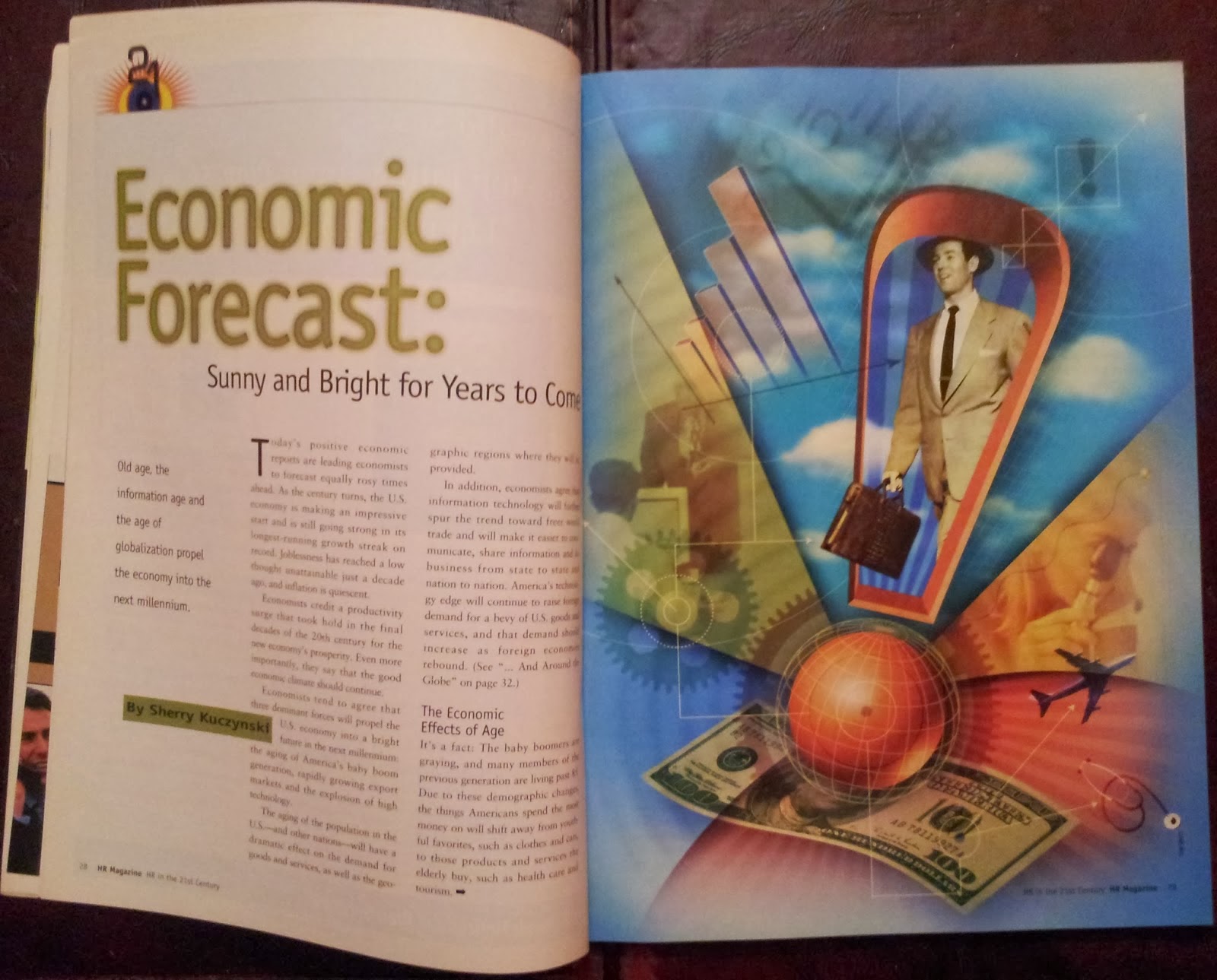
I was cleaning up the office that I use when I work onsite for one of my clients when I came across a stack of magazines. They were from HR Magazine, which is published by SHRM, the world's largest Human Resources association.
I love HR, but does anyone else?
It's been a while since I saw one so I started looking through them. And then I saw this one:
A collector's item, perhaps?
It's from 1999. Wow.
You can't see it in this picture but there's more to the headline than just "The 21st Century." At the bottom it states, "What's in Store for HR?"
Inside, there are various articles, all attempting to answer the above question. The contributors discuss the different generations in the workplace. They attempt to interpret the potential legal, technological, and economic landscape that Human Resources practitioners may find themselves in. Advice is offered on how HR and business leaders can best prepare themselves for these changes. 
The future's so bright, I gotta wear shades...
As with any attempt to peer into the future, some of what's discussed seems to be an extrapolation of (then) current information. For example, the idea that when Baby Boomers retire it will potentially bring about a shortage of skilled workers.

"From 2000 to 2020, annual unemployment rates fluctuate between 3.5 percent and 6.5 percent, averaging about 4.7 percent."-quote from an article within the 1999 HR Magazine

Back in 1999 I wasn't a HR professional yet. I wasn't focused on the future. My mind was on the present, which consisted of bills and building a relationship with my future wife. Oh, and the Y2K scare.
Were HR/business leaders at the time looking ahead? Were they preparing themselves and their workforces? And could anyone have predicted the last 14 years?
  • Terrorism
  • Global Recession
  • The rise of the global economy, particularly Brazil, Russia, India, China, and South Africa (the BRICS)
  • The United States electing its first African American President
As we've seen, the future is chaos. While we can get some things right, it's impossible to figure out completely. Regardless of how we may feel about the events that have shaped our current reality, it's important to never stop looking to and preparing for the future. We owe it to ourselves, and to those we impact.

How are you preparing yourself and your workforce for the future?


Thursday, October 31, 2013

Freaks Come Out at Night

Multiple shifts often mean multiple sub-cultures.  The way things are done during the day shift, for example, can vary (sometimes greatly) from how they are done during the night shift.  An us/them effect can take over and the disparity in attitude can cost an organization in lost productivity and higher payroll due to paying more for the extra time it takes to get things done.  

In one organization I got to be a part of some years ago, the day shift thought the night shift was a bunch of freaks.  They would spend part of their work day and break time discussing how dumb, crazy, stupid, bizarre and idiotic the night crew was.  Sounds productive and helpful to the culture, right?


Management has one choice in this type of situation - Get up.  Get out of your ergonomic chair and get on the floor.  Engage with the sales teams, line workers and administrative staff.  OK, how?

  • Change the tone and type of conversation by being an example of healthy communication and encouragement towards goals.  Make the decision to not participate in smearing an entire team's or group's reputation.  If an employee thinks the night shift is filled with freaks, ask why?  Challenge the basis, not argumentatively, but directly. 
  • Consistently be seen.  This effort cannot be a "one and done" deal.  It cannot be a once per month which happens to fall during the same time each month.  It cannot be done daily at the same time.  Mix it up.  Catch people outside of habit or comfort.  Allow them to be affected by your presence.  Your mere presence should give cause for employees to pause and think about what they are about to say to someone else.
  • Don't allow comfort to get in the way.  You're going to have to do these things on all shifts.  Only engaging with the shift that is most convenient to your schedule will fall short.  Those workers on the shift you hardly come to see will know it.  It's not hard to amplify an us/them feeling when you're dealing with multiple shifts and teams.  The likely winners are usually the Monday through Friday day shift.  They are able to work with the bulk of senior management and administrators during the "normal week" schedule.  You cannot allow that to be the perspective; it will foster the feeling that any other shift is less than desirable.  Get up on a Saturday.  Go into work at 3AM for the overnight crew (just leave early from work the next day).  It's a little inconvenient but it's an appropriate message to those employees.

Simply, be present and persistent.  Set a tone that you would want others to follow.  Don't wait for someone else to start it (scary, I know).  You set the bar and start the momentum.  Don't look to the right or to the left for someone else to champion the cause.

The only freaks that ought to be named should be those who do not extend themselves for the betterment of the company.  What would it mean to your company if this were true?  The anomalies of the company are those who are not present fully and persistent in protecting culture.  Nothing scary about that!


Wednesday, March 27, 2013

You're the One That I Want

Remember being the "captain" of your lunchtime team?  You know, choosing sides for kickball.  I know the focus of this type of memory usually revolves around the kid that was picked last, but let's instead look at the first one chosen.  You know, that kid that was just the best at everything; he/she could kick a ball farther, run quicker and look cool while doing it.  The two captains would guess a number between 1 and 10 or draw straws or punch each other until someone cried "mercy" (yeah, it was tough being a kid in Philly) in order to determine who chose first.  And then, that miracle kid was chosen and the game was all but over before it began.

While I was not that kid, I was a captain at times.  When I could pick Richie (that kid), I knew we would win.  Nothing like a bunch of boys in Catholic school uniforms playing handball in the schoolyard or stickball on the street.  Nostalgic, yes, but a lesson in fighting for talent.

Workforce planning is a wonderful exercise and one that can help an organization chart out its future needs.  Being strategic in cost management and production output helps greatly in an organization's competitive advantage.  That company can operate leaner and meaner.  Perhaps you've gone through the exercise of developing a workforce plan for one of your business units or departments.  Deciding on a strategy to meet those future needs leads to a few conclusions.

My colleagues at DoubleStar do a nice job with outlining strategies.  Perhaps it's time to GROW internal staff through training and/or development to close the gap that future needs will certainly show.  Perhaps, instead, it might make more sense to BORROW workers through contractors or outsourced means.  Maybe it's abundantly evident that the future needs for the workforce can only be met by EMPLOYING external candidates to bring much needed competencies into the organization.  Rarely done, but still an option, is to PARTNER with other companies in sharing talent resources.  And the least popular strategy, but one that sometimes needs to happen, is to REDUCE the workforce in light of a business reduction or process improvement that will cause fewer workers to be needed.

These strategies will prove effective.  However, they will only prove to be when a thorough analysis of the business and its current workforce is done.  Throwing these terms around with your executive is not a great idea if you cannot deliver what they mean.  Be mindful of your approach.

Lest you think I have forgotten about "Richie," I have not.  What does your organization do with a "Richie" that lands on your doorstep?  Do you take a look at his/her credentials, KSA's, work history and then say, "Sorry, we don't have anything open right now, but I will keep your resume on file"?  If he/she is a superstar, will your organization really let him/her walk out the door?  Sadly, for many companies, the answer is yes.

Workforce planning is just that.  It's planning.  It's being responsible with the talent you have in front of you and with what you reasonably think will be needed over the next three years or so (maybe five years).  What you cannot plan for is the ace who walks in your front door.  This one person can change the course that some of the workforce plans were based upon.  So the question is not "do we have an opening?" but rather "where can I put this person today?"  This person may just be the one that's needed to open up new doors of business, to develop a new process for improvement, or to invent a new product/service for deployment into the markets.

Think of it this way, I am a huge Phillies fan.  Kyle Lohse is not a Phillie, but if for some reason he showed up on Ruben Amaro's doorstep looking for a job, the Phillies would be foolish not to make it work.  I know there are salary issues that would have to addressed, rotation schedules to be changed and plans to be revamped.  So what?  The Phillies organization, like any other organization, would have to evolve and re-calibrate to chart the course to win.  Isn't that what we are supposed to encourage in our companies?

Don't hold onto those workforce plans like they are infallible and unchangeable.  They are a chart based upon information from today.  If tomorrow, a "Richie" curve ball is thrown into the mix, then adjust.  Don't deny this talent a place in your organization.  Many years ago, I worked for a company that told me, "John, if you interview someone that you think is amazing and brings strength to our team, then let's find a place for that person."  That's a superb order.  We should fight to bring that kind of talent in when we can.

As I shared, when Richie was picked first, it was a guarantee that the team he was on would win.  The opposing team would just grit their teeth and play through their frustration.  They made plans for new ways to attack the situation and moved people around until the best use of talent was happening.  The other team adjusted to the situation.  And because of that, they were more open.  So when a new kid, Dave, came to the school, that team was more willing to have him join them.  They were open and eager to see how he could fit in to help them win.  And on that day, they did.  Dave was as good as Richie.  


Wednesday, December 5, 2012

Bend Me, Shape Me

Flexibility in the workplace is not a new concept.  For years, we've heard about it from both the employee and the employer perspective.  There have been books and articles written about the 5, 8, or 10 steps in workplace flexibility (I know that there are other numbers of steps, but you get the idea).  Lectures have been given, speakers have been paid and enthusiastic companies have implemented short-lived flexibility plans.  SHRM has resource after resource of material and case studies for review.  So what more can be said?

How about this question: What is the business case for workplace flexibility?  Too often the goal seems to be flexible people with flexible schedules working for flexible companies.  What the heck does that even mean?!  One thing I do know is that profitability is not supposed to be flexible.  It's supposed to increase and move along a trajectory of growth.  I don't want the success of a company to be measured in its constant ability to reinvent itself at the cost of its core product or service all in the name of flexibility.  What if Apple decided that since being flexible is the latest rage, it would add a restaurant chain and a apron manufacturing subsidiary to its business?  Silly and over-the-top, right?  However, the point is that many of us in HR forget about what the company we work for is really about.

The company is about making money.  Every person working in the organization is in sales (just ask Todd Cohen).  What the company is selling is its product or service to the global market.  We don't want to take our eyes off the ball for the sake of being flexible.  What if it won't work to have flexible staffing for your organization?  What if you really need people to work the manufacturing equipment from 9AM to 5PM?  Those employees cannot telecommute.  They might not be able to have "fluid hours" (a new phrase I've heard).  Sometimes, the work has to be done in a certain time and in a certain way.  So, I ask you, are we to say that company is not flexible?

Sometimes being inflexible is just what's needed.  Sticking to what you know the business is about ought to be protected by the C-Suite and HR.  There is a vast difference between studying markets and preparing for changes in production, assembly and marketing compared to putting programs in place to make employees happy at the destruction of the work itself.  Some of those companies have granted their employees the most flexible schedule imaginable...the companies closed their doors.

Please hear me clearly, I am flexible.  I am a pretzel.  In HR, we have had to walk into each day ready to conquer whatever comes our way.  However, that is to be done to protect the core steady belief in the mission and vision of the organization.  We have to take hold of those non-negotiables and refuse to apologize.  The company's success will depend on someone somewhere making a decision and sticking with it.  We cannot be flexible about everything.  You're not a bad HR person if you cannot be flexible all the time.

Re-read those mission statements.  They are matter-of-fact and unapologetic in what the goal of the company is.  Inflexible?  Nah, right on the money.